

A six location group running MarginEdge pays $25,200 a year.
That figure is before the general ledger, before the fee Toast charges to connect it, and before anyone does the actual accounting. Add the Toast connection and it reaches roughly $28,800.
I start with that number because every guide to restaurant bookkeeping software I read quotes a monthly price for one tool and stops. Restaurants do not buy one tool. They buy a stack, and the stack is where the money goes.
So this is a guide to the three layers, what each one costs, and which combinations actually make sense.
Why Most Restaurant Bookkeeping Software Lists Get It Wrong
Search for restaurant bookkeeping software and you will be told to buy MarginEdge or xtraCHEF.
Neither of them keeps your books, which took me a while to realise.
What they do is capture invoices, cost your recipes, track food cost and push journal entries into QuickBooks or Xero. Your ledger, your chart of accounts, your bank reconciliation and your month end close all still live somewhere else.
I am not criticising either product. It is a category problem. Buy one expecting bookkeeping and you will still need a general ledger, and the guide that sold it to you never said so.
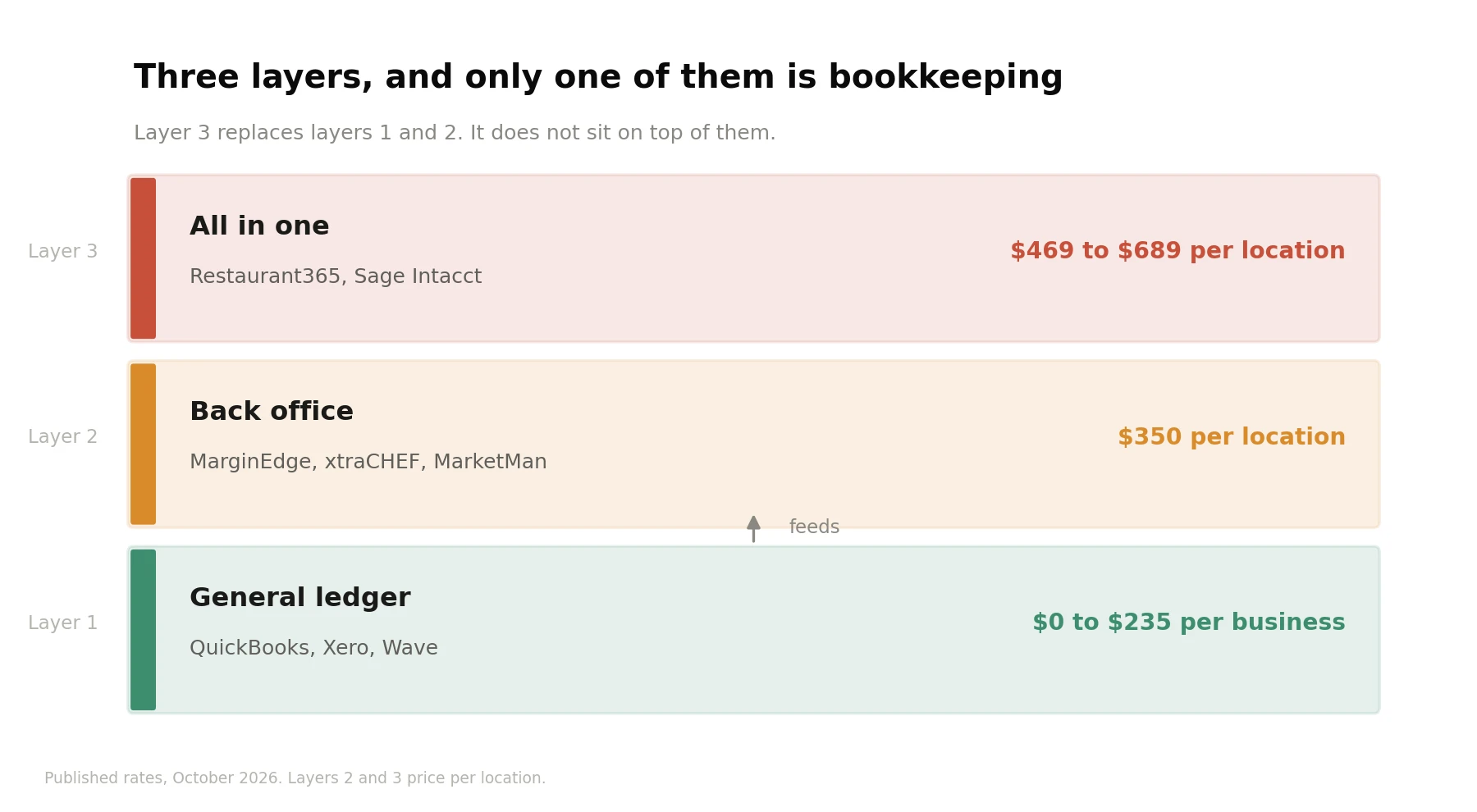 Here is how I would split the three layers.
Layer one, the general ledger. QuickBooks Online, Xero, Sage Intacct, Wave. This is bookkeeping in the proper sense: chart of accounts, journal entries, bank reconciliation, financial statements.
Layer two, the restaurant back office. MarginEdge, xtraCHEF by Toast, MarketMan, Craftable. Invoice capture, accounts payable and AP automation, vendor management, recipe costing, inventory counts, daily food cost. Feeds layer one, does not replace it.
Layer three, the all in one. Restaurant365, and at the larger end Sage Intacct with restaurant modules. Ledger and back office in a single platform.
You always need layer one. Whether you need layer two depends on invoice volume. Layer three replaces both, at a price I would think hard about.
What Each Layer Costs
I checked the published prices directly rather than repeating figures from comparison articles, because I found those figures disagreeing wildly.
Layer one. Xero runs roughly $15 to $80 a month. QuickBooks Online runs roughly $35 to $235 depending on plan, with most restaurant setups landing around the Plus tier. Wave is free and suits food trucks, pop ups and small caterers. Sage Intacct starts around $1,000 a month and is built for multi-entity groups needing consolidated reporting.
Layer two. MarginEdge is the only one in this layer publishing a real number, a flat monthly rate rather than a quote, and I think that transparency is worth something on its own.
Layer three. Restaurant365 publishes a starting range of roughly $469 to $499 per location per month for its Essential plan, with an accounting plus operations bundle around $539 on annual billing and Professional nearer $689.
Note how those scale. Layer one is priced per business. Layers two and three are priced per location, so multi location growth changes the maths more than any feature does. For a single restaurant the gap looks small. For a group it compounds every time you open a door.
MarginEdge Pricing, Checked at Source
Since this is the one published figure in the back office layer, I want to be precise about it.
MarginEdge's pricing page lists a flat $350 per location per month. Annual billing takes 10 percent off, which the company describes as saving $420 a year on one location, so call it $315 a month equivalent against a twelve month term.
The base price includes unlimited invoices processed, unlimited US bill payments, unlimited email support and one to one software training. Contract length is the catch: none on monthly billing, twelve months if you take the annual discount. Its Freepour beverage add on, a smart scale for liquor counts, is a further $150 per location per month, taking the bundle to $500.
Two things that are not in the sticker price.
The Toast fee. Connecting MarginEdge to Toast requires Toast's Restaurant Management Suite at roughly $50 per location per month. MarginEdge is open about this, stating that Toast charges partners per location per month and that the fee is passed through and visible in your billing. That is Toast's charge, not MarginEdge's, but it lands on the same invoice. Six locations means $3,600 a year on top.
No free trial. There is a guided demo and paid onboarding rather than a self serve trial.
So the real numbers. One location on MarginEdge is $4,200 a year. Six locations is $25,200, or $28,800 with the Toast connection. Those are the figures I would put in a budget, not the sticker. The same gap between the sticker and the real cost shows up in other small business software, and I walk through it for a vendor that hides its prices in my Urable pricing guide.
What Restaurant365 Actually Costs
Restaurant365 is the all in one, and the reason four different articles quote four different prices for it is that it sells by quote above a published starting range.
Published figures put Essential at roughly $469 to $499 per location per month, the accounting and operations bundle around $539 on annual billing, and Professional near $689. Other sources quote ranges from $199 to $1,500, which tells you the final number depends heavily on modules, location count and negotiation.
What you get for it is genuinely broad: accounting, inventory, scheduling, payroll and AP in one system, with proper restaurant period accounting rather than calendar months.
What you pay beyond money is time, and I would plan for that. Implementation is measured in weeks to months, not days.
My rough line is five locations, though I would run your own numbers. Below that, a ledger plus a back office tool usually wins on both cost and speed. Above it, running two systems starts to cost more in reconciliation effort than the all in one costs in licence fees.
The Buyer Nobody Writes For
Here is a gap I genuinely did not expect to find.
Every guide on this keyword is written for an operator buying software for their own restaurants. None are written for the external bookkeeper with a roster of restaurant clients, even though that person searches this exact term.
For them the per location model breaks completely. An external bookkeeper with eight restaurant clients would be looking at around $1,592 a month on Restaurant365 at the low end of its reported range, before doing a single hour of work.
If that is you, I would build a different stack. QuickBooks Online across the roster, plus a POS to ledger integration layer such as Shogo or Bookkeep to automate the daily sales journal entry, gives you consistent entries across a mixed client base without paying per location for operational features your clients will never open.
Restaurant365 is excellent software aimed at a different buyer. I would rather say that plainly than score it down for failing at a job it never claimed.
What Actually Makes Restaurant Accounting Hard
Software choice matters less than I expected before writing this. In my reading, these four things cause the real pain.
Daily sales entries. A restaurant posts sales daily, not per invoice. Your POS has to map into the ledger cleanly or every month end becomes archaeology.
Tips and sales tax. Tip allocation, tipped wages and the sales tax liability sitting inside daily takings are where generic bookkeeping software for restaurants falls apart. Ask specifically how any tool handles tips before you buy it.
Period accounting. Many restaurants run four week periods or a thirteen period year rather than calendar months, so that weekday counts stay comparable. QuickBooks does not do this natively. Restaurant365 does.
Prime cost. Food cost plus labor cost as a share of sales is the number operators actually run on, and it needs both COGS and payroll in the same view to produce a usable P&L. That is the real argument for layer two or three.
If your chart of accounts and POS mapping are a mess, I do not think any platform in this article will produce numbers you can trust. Fixing that first is cheaper than any licence.
Which Combination to Buy
Food truck, pop up, cafe, bar or small caterer. Wave or Xero alone, which is the realistic answer to small restaurant accounting on a tight budget. You do not have the invoice volume to justify anything else.
Single restaurant under roughly 50 invoices a month. QuickBooks Online plus a POS integration. Skip layer two entirely for now.
Single restaurant with real invoice volume. QuickBooks Online plus MarginEdge at $350. This is the most common sensible stack I came across, and when I checked the maths it holds.
Already on Toast POS, Square or Clover. On Toast, compare xtraCHEF against MarginEdge carefully. On Square or Clover, your choice in layer two is wider because no pass through fee applies. xtraCHEF sits natively inside Toast with no pass through API fee, which closes part of the price gap. It does not publish pricing, with Capterra reporting $149 per feature per month, so you will need a quote.
Two to four locations. Still ledger plus back office, usually. Run the comparison at your location count before assuming otherwise.
Five or more locations. Restaurant365 starts to make sense, particularly if you need inventory, scheduling and payroll in the same place.
External bookkeeper with multiple clients. QuickBooks Online plus an integration layer. Avoid per location platforms.
This layered approach is not unique to hospitality. Plenty of operational systems are built to feed an accounting platform rather than replace it, which is the same pattern I described in our write up of Recibo, where field sales and distribution data syncs into QuickBooks or Xero instead of trying to become the ledger.
What Operators Actually Ask
What is the best bookkeeping software for restaurants?
For most single locations, QuickBooks Online with a POS integration. Add MarginEdge at $350 per location when invoice volume becomes the bottleneck. Restaurant365 once you pass roughly five locations.
Do restaurants need special accounting software for restaurants?
Not always. You need a general ledger, and that can be QuickBooks or Xero. Restaurant specific software earns its place when food cost, recipe costing or period accounting matter.
Is MarginEdge accounting software?
No. It is a back office layer that processes invoices and costs recipes, then syncs to your accounting software. You still need a ledger underneath it.
Is QuickBooks enough for a restaurant?
For a single location with a straightforward menu, usually yes. Its limits are period accounting, recipe costing and prime cost reporting.
How much does Restaurant365 cost?
Published figures put Essential at roughly $469 to $499 per location per month, with higher tiers around $539 and $689. Final pricing is quoted.
How much does MarginEdge cost?
A flat $350 per location per month, or about $315 on annual billing with a twelve month term. The Freepour bundle is $500.
What is the difference between MarginEdge and Restaurant365?
MarginEdge is one layer that plugs into your existing ledger. Restaurant365 replaces the ledger as well. One is an addition, the other is a migration.
Which restaurant accounting software works with Toast?
All three. xtraCHEF is native to Toast, MarginEdge connects through Toast's Restaurant Management Suite at around $50 per location per month, and Restaurant365 integrates too.
Is there free restaurant bookkeeping software?
Wave is free and workable for food trucks and very small operations. There is no free option in the restaurant back office layer.
When should a restaurant move off QuickBooks?
When you are running multiple locations, need consolidated reporting across entities, or spend more time reconciling between systems than the all in one would cost.
What is prime cost?
Food cost plus labour cost as a share of sales. It is the headline number most operators manage against, and tracking it properly needs COGS and payroll in the same system.
Buy in This Order
If you are starting from spreadsheets, the sequence matters more than the shortlist.
First, I would fix the chart of accounts and the POS mapping. Every tool here inherits whatever mess exists underneath it. This step costs nothing but attention and it decides whether anything downstream produces usable numbers.
Second, buy the ledger. QuickBooks Online or Xero, with the POS integration configured properly and daily sales entries landing automatically.
Third, I would run that for a quarter. You will learn whether invoice volume is genuinely a problem or whether it just felt like one.
Fourth, add the back office layer if the invoices are drowning you. MarginEdge at $350 is the benchmark to compare everything else against, because you can see its price without a phone call.
Fifth, consider the all in one only when you are managing several locations and the reconciliation between systems has become its own job.
Most operators I have seen get into trouble by starting at step four or five. The platform arrives, nobody has fixed step one, and the expensive new system produces the same unreliable numbers faster.
Prices here come from MarginEdge's own pricing page and from published starting ranges and comparison data for the other platforms, checked in October 2026. Restaurant365 and xtraCHEF quote privately, so treat those figures as starting points rather than quotes.