

On 22 May 2026, the Delhi High Court did something no court had done before. It held Google itself liable for selling a company's registered trademark as an advertising keyword.
The case was Hindware Limited against Grohe India and Google, and the judgment ran to 163 pages. The court granted a permanent injunction stopping Google from auctioning the HINDWARE mark as a keyword, and awarded thirty lakh rupees in damages.
I am opening with that because brand bidding spent fifteen years as a commercial nuisance, and in one jurisdiction it has just become a legal one.
The rest of this is what brand bidding actually is, what it costs, how to find it, and the policy wording that stops it.
What Is Brand Bidding?
The way I would define brand bidding is this: someone other than you buys your brand name as a paid search keyword, so their ad appears when people search for you.
Sometimes it is the exact name. More often it is the name plus a modifier, because that is where buying intent sits. Your brand plus coupon. Your brand plus discount code. Your brand plus review, pricing, or alternatives.
It also covers misspellings and typosquatting, where somebody bids on the version of your name that people fat-finger into the search bar.
You will see it called TM plus bidding, trademark bidding or brand term bidding. Same practice, different vocabulary.
Brand Bidding in Affiliate Marketing, and the Competitor Version
Almost every article I read on this topic treats brand bidding as an affiliate programme problem. I think that is half the story, and the half that matters depends entirely on who you are.
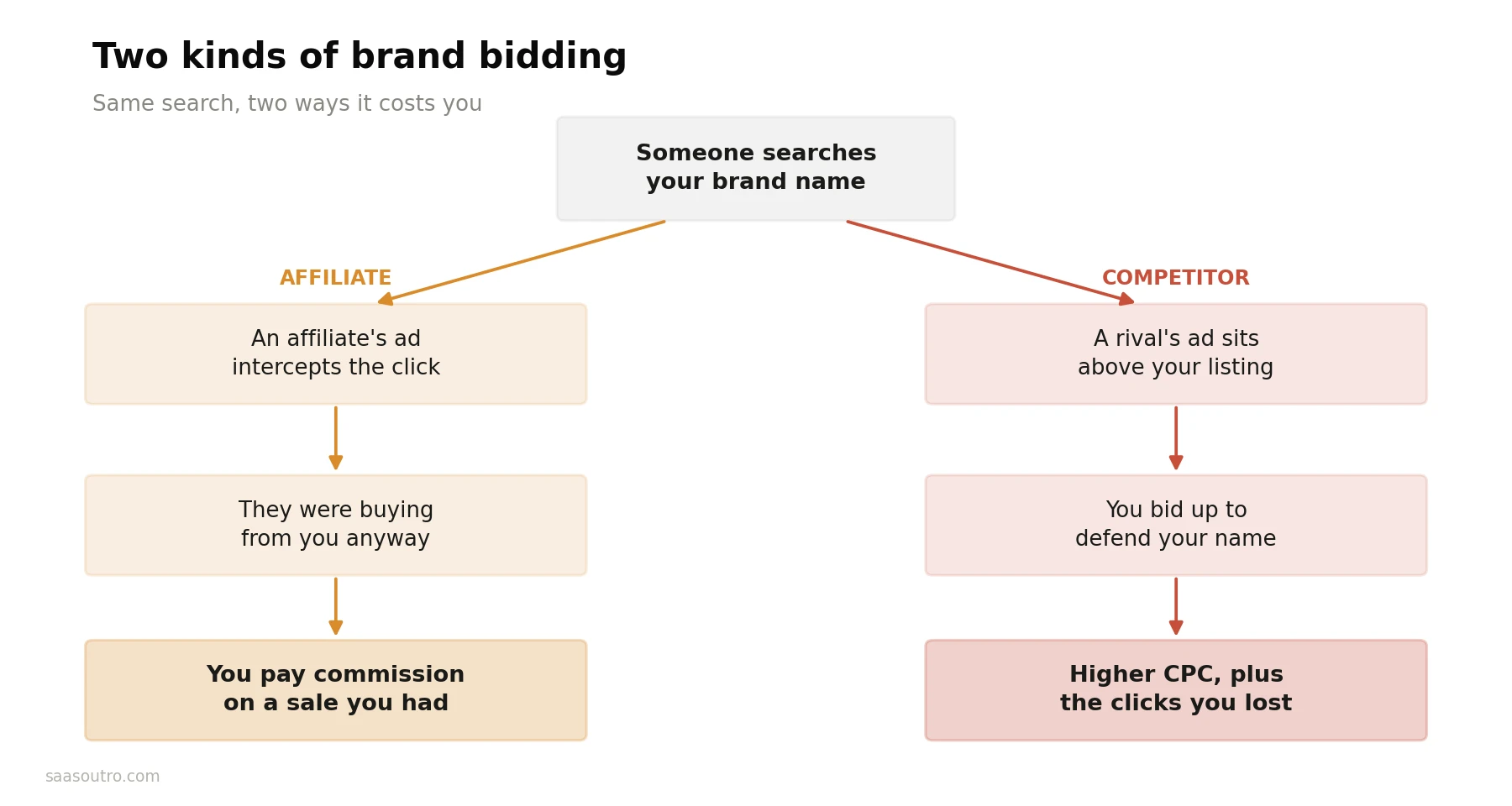 Affiliates and partners. Someone in your own programme bids on your brand name, intercepts a customer who was already walking through your door, and claims commission on the sale. You pay for a conversion you would have had for free.
In my view this is the version that hurts most in ecommerce and in any business with a large partner programme. It is also the version you can fix fastest, because you have a contract with the person doing it.
Competitors. Competitor bidding works differently. A rival bids on your name to put their ad above your organic listing. You do not pay them commission, but you pay in two other ways: a higher cost per click to defend your own brand term, and the customers who click the other ad and never arrive.
This is the version that hurts most in B2B and SaaS, where there is no affiliate programme to police and the person bidding has no agreement with you at all.
If you are a SaaS company reading affiliate-focused advice, most of it will not apply. The policy sections assume leverage you do not have.
What Brand Bidding Actually Costs You
I count four separate costs, and only the first is visible in your ad account.
Inflated cost per click. Once someone else is bidding on your name, the auction has competition in it. Your own branded CPC rises, on terms you were previously winning cheaply.
Commission on customers you already had. The affiliate version of the problem. Last-click attribution means the affiliate who intercepted the final click gets credited for the whole sale.
Distorted performance data. Brand bidders look like your best affiliates, because their conversion rates are superb. They are converting people who had already decided. Reward them for it and you scale the problem.
Customer acquisition cost that will not come down. You are paying twice for the same customer, and your blended CAC never improves no matter what you optimise.
The second and third are the pair I would worry about, because together they are invisible. The numbers look good. The partner looks productive. Nothing in your dashboard says the money was wasted.
Is Brand Bidding Legal?
It depends where you are, and I think 2026 made that answer more complicated rather than less.
In Europe, the position has been settled since 2010, when the European Court of Justice held that using a competitor's trademark as a keyword is in principle permitted. The line is drawn at confusion. Bid on the name quietly and you are generally fine. Use it in your visible ad copy in a way that misleads people about who you are, and you are not.
In the United States, keyword use alone has generally not been treated as infringement, though cases such as Rosetta Stone against Google show the question is fact-specific rather than closed.
In India, the ground shifted in May 2026. The Delhi High Court's judgment in Hindware held three things at once: that invisible backend keyword use is still use of the mark, that Google is an active participant rather than a passive intermediary, and that safe harbour under Section 79 of the IT Act therefore does not protect it.
Here I would be careful, because the marketing coverage of that ruling has overstated it.
Plenty of articles now say brand keyword bidding is banned in India. Legal analysis of the same judgment reads it more narrowly.
The court was dealing with a coined and well-known mark, and an earlier Division Bench position in Google LLC against DRS Logistics sits behind it. So the safer reading is that invisible keyword bidding on a strong, distinctive registered mark is now actionable in India, not that every brand term everywhere is protected.
One more detail worth knowing. As of mid 2026, Google's own keyword policy in India still permitted trademark terms as keywords, which puts the platform's policy and the court's ruling in direct conflict.
None of this is legal advice, and I am not a lawyer. If you are considering enforcement, the jurisdiction you are in changes the answer completely.
How to Detect Brand Bidding Without Monitoring Software
This is where I think most advice falls apart, because searching your own brand name once from your own desk tells you almost nothing.
Brand bidders are frequently geo-targeted and time-targeted, specifically so the brand's own team does not see them. If the violation runs at 11pm in Germany and you are checking at 10am in London, you will never find it.
So if you are checking manually, vary three things.
Location. Use a VPN and check from each market you sell in, not just your own.
Time of day. Morning, afternoon and late evening, in that market's local time.
Term. The brand alone, plus the modifiers. Brand plus discount code, plus promo, plus review. The modifiers are where affiliates live.
Four countries, three times, four terms is 48 searches. It takes about ninety minutes and it will tell you more than any dashboard.
One trap to avoid. Affiliate ads routinely use cloaked display URLs that show your own domain, so the ad looks like yours until you click it. Check where the link actually lands, or you will undercount badly.
Do all that manually and you have a snapshot. Brand bidding monitoring tools exist precisely because the snapshot goes stale, and I went through what they cost in this comparison of AdPolice alternatives, where the published entry point for paid search brand protection sits around $500 to $800 a month.
How to Stop Brand Bidding
Five things, ordered by how much I think each returns for the effort.
Write a specific policy, not a vague ban. This is the single biggest failure I see.
A line saying no brand bidding is unenforceable in practice, because it leaves every edge case open. Does it cover misspellings? Brand plus coupon? Display URLs containing your name? Ambiguity gets exploited, and the affiliate will argue, fairly, that nothing told them otherwise.
Add your own brand terms as negative keywords in partner briefs, and require it in writing. Many violations are genuinely accidental, caused by broad match or by automated campaign types pulling in brand queries nobody explicitly bid on.
File a Google Ads trademark complaint where your mark is being used in visible ad copy. Microsoft runs an equivalent process for Bing, and PPC teams often forget the second one entirely. This works reasonably well for ad text. It has historically been far weaker for invisible keyword use, which is precisely the gap the Hindware ruling attacked.
Report violations to the affiliate network. This is where the leverage actually is. Networks can withhold payment or trigger commission clawback, and a violation report from the merchant carries real weight. Where the bidder is not a partner at all, a cease and desist is the next step rather than the first.
Bid on your own brand. I would not call owning the top ad slot on your own name wasted spend when somebody else is trying to take it. It is cheaper than the alternative, because your quality score on your own brand term is high and theirs is not.
Should You Bid on Your Own Brand Name?
The honest answer is that it depends on whether anyone else is.
If your branded SERP is clean, with your organic listing at the top and nobody advertising against it, paying for clicks you would get free is hard to justify.
If somebody is bidding on you, the maths changes immediately. You are not buying traffic, you are defending position, and your own brand term will almost always be cheaper for you than for the intruder.
So I would not treat this as a standing policy. I would treat it as a response, switched on when monitoring shows a problem and reviewed when it clears.
A Brand Bidding Policy Template That Actually Holds
I want to finish on the practical part, because a vague policy is the root of most affiliate brand bidding.
Your affiliate agreement wants four things spelled out, and this is the skeleton of a workable brand bidding policy template.
A definition of what counts. Name the categories explicitly: the exact brand name, misspellings and phonetic variants, the brand name with any modifier, the brand name in display URLs, and the brand name in ad copy. If it is not listed, expect it to be argued.
A three-tier classification. Blocked, meaning never. Restricted, meaning only with written approval, which is where a whitelist of legitimate partners running brand campaigns on your behalf belongs. Allowed, meaning everything else. A single blanket ban is easier to write and much easier to evade.
A cure period with a stated clock. Something like 48 hours from notice to remove the ads. This matters because it converts an argument into a deadline.
Consequences in sequence. First violation triggers the cure period. Second triggers commission withholding on affected conversions. Third triggers clawback and removal from the programme. Writing the sequence down does more work than any single penalty, because the affiliate can see where it ends.
Add one sentence requiring partners to add your brand terms as negative keywords, plus a line reserving your right to run compliance monitoring, and you have removed the accidental violations entirely, which in my reading is a meaningful share of them.
Brand Bidding, Answered
What is brand bidding?
Buying another company's brand name as a paid search keyword so your ad appears when people search for that brand.
Is brand bidding illegal, and is it trademark infringement?
It varies by country. Whether it counts as trademark infringement is the real question, and Europe has permitted keyword use in principle since 2010 where there is no confusion. In India, a May 2026 Delhi High Court ruling made invisible keyword use on a well-known registered mark actionable, and held Google liable.
Why do affiliates bid on brand keywords?
Because it converts extremely well. The customer had already decided, so the affiliate collects commission for intercepting the last click.
How do I know if someone is bidding on my brand?
Search your brand and brand-plus-modifier terms from several countries at several times of day, and check where each ad actually lands rather than trusting the display URL.
Can I stop competitors bidding on my brand name?
Not directly in most jurisdictions, unless they use your mark in visible ad copy. Your realistic options are a trademark complaint, legal action where local law supports it, and outbidding them on your own term.
Should I bid on my own brand keywords?
Only when someone else is. Defending a contested branded SERP is worth it. Paying for clicks nobody is competing for usually is not.
What is a brand bidding policy?
The section of your affiliate terms defining which brand-related keywords partners may use, what approval is needed, and what happens when they break it.
Does a Google trademark complaint work?
For visible use of your mark in ad copy, often yes. For invisible keyword bidding, historically much less so.
What is TM plus bidding?
Another name for the same practice, referring to bidding on a trademark plus a modifier term.
Do I need monitoring software?
If you sell in more than one country or run an affiliate programme of any size, manual checking will miss geo-targeted and time-targeted violations. That is the gap monitoring tools fill.
Legal points in this article come from published analysis of the Delhi High Court judgment in Hindware Limited against Grohe India and Google, decided 22 May 2026, and from the European Court of Justice position established in 2010. This is general information rather than legal advice, and the position differs by jurisdiction.