

Your branded cost per click went up this quarter. Your conversion rate from paid traffic went down.
Those look like the same problem to me. They are not, and they need different software.
I ended up writing this because brand protection vs click fraud is the comparison that quietly ruins buying decisions in this category. The two get listed side by side in the same alternatives roundups, as though you pick one. You do not pick one. They answer different questions about the same partner.
The Two Questions
Strip away the product names and I think each category asks exactly one thing.
Brand protection asks: is this partner following the rules? Are they bidding on your brand name, using your trademark in ad copy, cloaking the display URL, ad hijacking your own listing, breaking your pricing policy? That is compliance monitoring, and the output is evidence and a takedown.
Click fraud tools ask: is this traffic real? Are these clicks from humans with genuine intent, or bots, click farms, replayed postbacks and duplicate conversions? That is affiliate fraud and invalid traffic detection, and the output is IP exclusion lists and blocked traffic inside Google Ads and Meta.
Here is the line that made the distinction click for me, and it comes from a click fraud vendor rather than a brand protection one. Anura's write-up on why typical tools fall short points out that an affiliate can follow every advertising rule and still send fraudulent traffic.
The reverse is equally true and I have not seen anyone say it. An affiliate can send a hundred percent real human traffic and still be robbing you blind, because those humans were already walking through your door and the affiliate just stepped in front of it.
Real traffic, stolen credit. Fake traffic, clean compliance. Those are different failures, and no single meter catches both.
That is the whole reason two categories exist, and the reason buying one and assuming it covers the other is the most expensive mistake available here.
The Four Partners You Actually Have
Put those two questions on two axes and I count four outcomes. Every partner in your programme sits in one of these boxes.
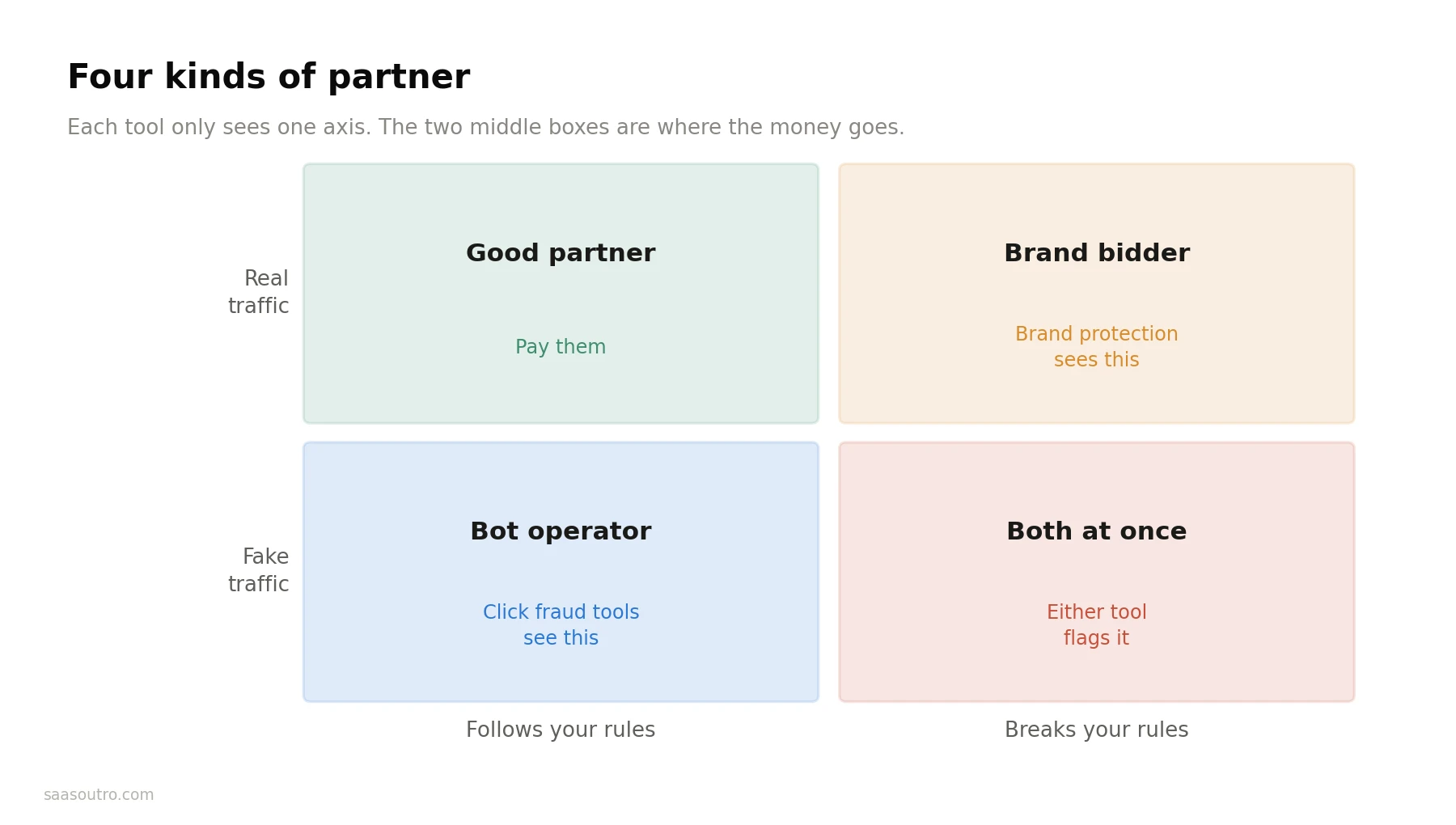
Follows the rules, sends real traffic. Your actual partners. Pay them.
Breaks the rules, sends real traffic. The brand bidder. Genuine humans, genuine purchases, commission on customers you already had. Only brand protection sees this one, because every click is legitimate.
Follows the rules, sends fake traffic. The bot operator. Nothing in their ad copy is wrong. The traffic is worthless. Only a click fraud tool sees this one.
Breaks the rules and sends fake traffic. Rare, and usually obvious once you look. Either tool will flag this one, which is why nobody argues about it.
The part I would hold onto is that the two middle boxes are invisible to the wrong tool. Buy a click fraud platform to stop brand bidding and it will report everything as clean, because it is. Buy brand protection to stop bot traffic and it will report full compliance, because that is also true.
How to Tell Which Problem You Have
This is the section I could not find anywhere, so here is how I would diagnose it from data you already own.
Signs you have a brand bidding problem. Your branded cost per click is rising with no change in your own bidding. Certain affiliates show conversion rates far above everyone else, often several times higher. Those same affiliates have very short time-to-conversion, because the customer had already decided. Your blended customer acquisition cost refuses to fall despite everything converting well.
The giveaway, in my view, is that the numbers look good. Brand bidders are your best-performing partners on paper, which is exactly why they survive so long.
Signs you have a traffic quality problem. Click volume is up and conversions are flat. Bounce rates from specific referrers are extreme. Time on site collapses for particular partners. Duplicate conversions appear against the same click identifier. One useful rule from affiliate management circles is to pull a thirty day click report by partner and flag anyone whose click-to-conversion ratio sits below half a percent on non-branded traffic.
Here the numbers look bad, which I would say at least makes the problem findable.
If both are true, you have both problems, and the order matters. I would fix brand bidding first, because that money is leaving as commission on real sales and the fix is contractual rather than technical.
One practical note on the diagnostic. Run it per partner, not in aggregate. A programme with forty affiliates can look completely healthy at the top line while two partners inside it are doing all the damage, and averages are very good at hiding exactly the behaviour you are hunting for.
What Each Category Costs
The pricing structures are as different as the products, which surprised me.
Brand protection is sold by quote, with a floor somewhere around $500 to $800 a month for a single module. The Search Monitor is the one publishing openly, at $800 a month for Brand Protection and $500 for Affiliate Compliance, both plus keyword crawling fees. AdPolice, BrandVerity, Marcode and Red Points all quote privately.
Click fraud tools publish their pricing per month and scale it to ad spend, which is a sign they sell to a self-serve buyer. ClickCease, Fraud Blocker and Lunio all sit at the accessible end. TrafficGuard, Anura and CHEQ sit at the enterprise end with broader invalid traffic coverage.
I read that difference as a signal about who each category expects on the other end of the call. Brand protection is sold to compliance and legal-adjacent teams. Click fraud is sold to whoever runs the ad account.
If brand bidding is the problem you are trying to solve, I went through what each option actually does, and what triggers it, in this guide to brand bidding.
The Overlap Zone
It would be cleaner if these stayed in separate boxes. They do not, and I would check this before buying, and the crossover is worth knowing before you buy twice.
Affiliate platforms are adding both. Impact.com now bundles paid search monitoring with invalid traffic detection in the same product, covering keyword violations and bot clicks together. If you already run your programme on a platform like that, check what you own before buying a standalone tool.
Click fraud vendors are adding affiliate modules. TrafficGuard offers an affiliate-specific module aimed at replayed postbacks, hijacked redirects, attribution abuse and invalid click traffic. One reported deployment took invalid traffic from twenty two percent to under eight percent within three weeks.
Brand protection vendors are adding traffic signals. The direction of travel is toward a single compliance view, though nobody has arrived yet.
Affiliate networks sit awkwardly in the middle. Most networks run some fraud filtering of their own, and some will act on a violation report without you owning any tool at all. Before buying anything, I would ask your network what it already monitors and what evidence it needs from you to withhold a commission. For a small programme that conversation occasionally removes the need for a purchase entirely.
My caution here is that bundled modules are usually shallower than the specialists. A paid search monitoring feature inside an affiliate platform will catch obvious brand bidding in your main market. It is less likely to catch the violation that only runs at 11pm in Germany behind a cloaked display URL.
Which Should You Buy First?
You run an affiliate or partner programme. Brand protection first. The leak is commission on sales you already had, it is invisible in your reporting, and you have a contract giving you leverage.
You run paid search with no affiliate programme. Click fraud first, or possibly nothing. If nobody is bidding on your brand and you have no partners, brand protection has little to do.
You are B2B or SaaS with competitors bidding on your name. Brand protection, though your enforcement options are narrower, since a competitor has no agreement with you to break.
You run high-volume lead generation. Click fraud, urgently. Fake leads cost you twice, once in media spend and again in the sales time chasing them. That second cost rarely appears in any marketing report, which is why lead gen teams tend to discover the problem late and through their sales colleagues rather than their dashboards.
You sell through resellers with pricing rules. Brand protection, and specifically a tool covering reseller compliance rather than just affiliates. The workflows differ more than vendors admit, because a reseller agreement and an affiliate agreement give you different enforcement routes.
You are doing none of the above but ad spend is rising. I would check Google Ads' own invalid click reporting before buying anything. It is free, it is already in your account, and for a small advertiser it may be enough.
Brand Protection vs Click Fraud, Answered
What is the difference between brand protection and click fraud software?
Brand protection monitors who is advertising on your brand and whether they follow your rules. Click fraud software checks whether the clicks reaching your site are real.
Do I need both?
If you run paid search and an affiliate programme, probably yes. If you run only one of those, probably not.
Will a click fraud tool stop brand bidding?
No. Brand bidding clicks come from real people with real intent, so they pass every validity check.
Will brand protection stop bot traffic?
No. A bot operator can comply perfectly with your advertising rules while sending worthless traffic.
Which is more expensive?
Brand protection, generally. It starts around $500 to $800 a month and is quote-based. Click fraud tools publish pricing and start much lower.
Can my affiliate platform do both?
Increasingly yes, at a basic level. Impact.com bundles paid search monitoring and invalid traffic detection. Depth is the trade-off against specialist tools.
How do I know which problem I have?
Brand bidding makes your numbers look good while your costs rise. Traffic fraud makes your numbers look bad. The direction of your conversion rate is the fastest signal.
Does Google not already filter invalid clicks?
It filters some, and credits you for what it catches. Third party tools target the sophisticated invalid traffic that passes those filters.
What if my affiliate follows every rule?
They can still send fraudulent traffic. Compliance and traffic quality are independent of each other, which is the whole reason both categories exist.
Which should a small business buy?
Usually neither at first. Check your own analytics for the signals above and use free platform reporting before committing to a subscription.
If You Can Only Buy One
Most of this article assumes you have a budget to decide between. Plenty of teams do not, so here is how I would force the choice.
Buy brand protection if you pay commission to anyone. The money leaving through brand bidding is commission on revenue you had already earned, it compounds every month, and it hides inside metrics that look like success. Nothing else you can buy will surface it.
Buy click fraud protection if all your spend goes to ads and nobody earns commission from you. The leak there is media spend on traffic that was never going to convert, and your own analytics will at least point at it.
And if you genuinely cannot tell which you are, spend a week on the diagnostic above instead of a month on demos. The data you need is already in your ad account and your affiliate report, and it will tell you which half of this comparison you can safely ignore.
Pricing and product descriptions in this article come from vendor pricing pages and published comparisons, checked in October 2026. Most brand protection vendors quote privately, so treat those figures as a floor rather than a quote.