

How many types of cloud computing services are there?
I checked five of the biggest names in the industry before writing this. Microsoft says four. Google says four. Red Hat says three. GeeksforGeeks says five. One provider lists three service models plus a fourth it calls new.
I do not think they are contradicting each other by accident. Each taxonomy quietly flatters whatever its author sells. Microsoft counts serverless separately, which is convenient when you sell a serverless product. Red Hat keeps the list to three and spends its energy on deployment models, which is convenient when you sell hybrid cloud.
So before anything else, here is the version that holds regardless of who is selling.
And then the part none of those pages include: what cloud computing services cost, and which line on the bill surprises people.
What Is Cloud Computing? A Definition That Holds
Cloud computing is renting computing resources over the internet instead of buying and running the hardware yourself.
That is the whole idea. Servers, storage, databases, networking and software, delivered on demand and billed for what you use. Microsoft's own definition puts it the same way, as the delivery of computing services over the internet for faster innovation and economies of scale.
Underneath the marketing, two questions decide everything about a cloud setup.
How much of the stack do you want to manage? That gives you the cloud service models.
Whose hardware is it running on? That gives you the deployment models.
Everything else in this category is detail hanging off those two questions.
The 3 Cloud Service Models
There are three. I am confident in that number because every disagreement I found was about whether to count serverless separately, and serverless is a billing and scaling model rather than a different layer of the stack.
Infrastructure as a Service. You rent raw compute, storage and networking on a pay as you go basis. Virtual machines, block storage, object storage, load balancers, and the regions and availability zones they sit in. You manage the operating system, the runtime and everything above it. AWS EC2, Azure Virtual Machines, Google Compute Engine, Hetzner, DigitalOcean.
I would pick IaaS when you need control, have unusual requirements, or are moving existing servers into the cloud roughly as they are.
Platform as a Service. You rent an environment to deploy code into. The provider handles the operating system, patching, autoscaling and the runtime, and usually offers a managed database alongside it. You bring the application. Heroku, Google App Engine, Azure App Service, Render, Railway, Fly.io.
I would pick PaaS when you want to ship software and have no interest in maintaining servers.
Software as a Service. You rent the finished application. Someone else runs all of it and you log in. This is the layer most people actually touch every day, from CRM to email tools, which is the whole category we list at SaaS Outro, including the email marketing platforms most businesses start with.
Where serverless fits. Functions as a Service, or FaaS, covering AWS Lambda and Cloudflare Workers, sits inside PaaS rather than beside it. Containers and Kubernetes sit in the same awkward place, somewhere between IaaS and PaaS depending on who manages the cluster. You still hand over code and the provider still runs the platform. What changes is that you pay per execution rather than per hour, and the capacity scales to zero when nothing is happening.
So I treat serverless as a pricing and scaling decision within PaaS rather than a fourth category. That is why counts of four and five exist.
The Deployment Models
Same stack, different landlord, as I think of it.
Public cloud. Shared infrastructure owned by the provider. AWS, Azure, Google Cloud, Alibaba Cloud, IBM Cloud. Cheapest to start, largest service catalogue, least control.
Private cloud. Infrastructure dedicated to one organisation, either on-premises or hosted for you. Chosen for compliance, data residency or predictable heavy workloads.
Hybrid cloud. Both, connected, with workloads placed where they fit best. The usual pattern is sensitive data staying private while everything else runs public.
Multicloud. More than one public provider at the same time. Usually driven by a wish to avoid vendor lock-in, or by acquisitions leaving you with two of everything.
Community cloud. Shared infrastructure for organisations with the same regulatory needs, such as government or banking. Rare, and mostly a regional phenomenon.
My honest note here is that hybrid and multicloud sound strategic and often arrive by accident. Plenty of multicloud setups exist because nobody consolidated after a merger.
Who the Cloud Service Providers Actually Are
Three companies dominate. AWS, Microsoft Azure and Google Cloud hold roughly two thirds of global market share between them, which matters because their pricing sets the reference point everyone else is measured against.
Below them sit IBM Cloud and Oracle Cloud, both stronger in enterprise and hybrid work than in startup adoption, and Alibaba Cloud, dominant in China.
Then there is a tier that rarely appears in definitional articles because the companies writing those articles are the hyperscalers. DigitalOcean, Hetzner, Vultr, Linode and the newer platform providers like Render, Railway and Fly.io serve smaller teams at a fraction of the cost, with a fraction of the service catalogue.
For a small team running a handful of services, I think that smaller tier is very often the right answer, and you will not read it on a page published by Microsoft.
What Cloud Computing Services Cost
Here is the section I could not find in a single vendor definition.
Cloud pricing has four components, and I would argue only the first is obvious.
Compute. Billed per hour, per second, or per execution for serverless. Discounted heavily for commitment, through reserved instances and committed use discounts, typically 30 to 70 percent off on-demand rates. Spot capacity goes cheaper still if your workload tolerates interruption.
Storage. Billed per gigabyte per month, with tiers by access frequency. Cloudflare R2 charges $0.015 per GB-month for standard storage, which is a useful reference point.
Operations. Charges per million API requests. Easy to ignore, occasionally significant.
Data transfer. Here is the one that catches people, and it deserves its own section.
Egress: The Line Nobody Puts in the Definition
Moving data into a cloud provider, called ingress, is free everywhere. Moving your own data out is not.
That charge is called egress, and it is the most extreme pricing difference I have come across in this industry.
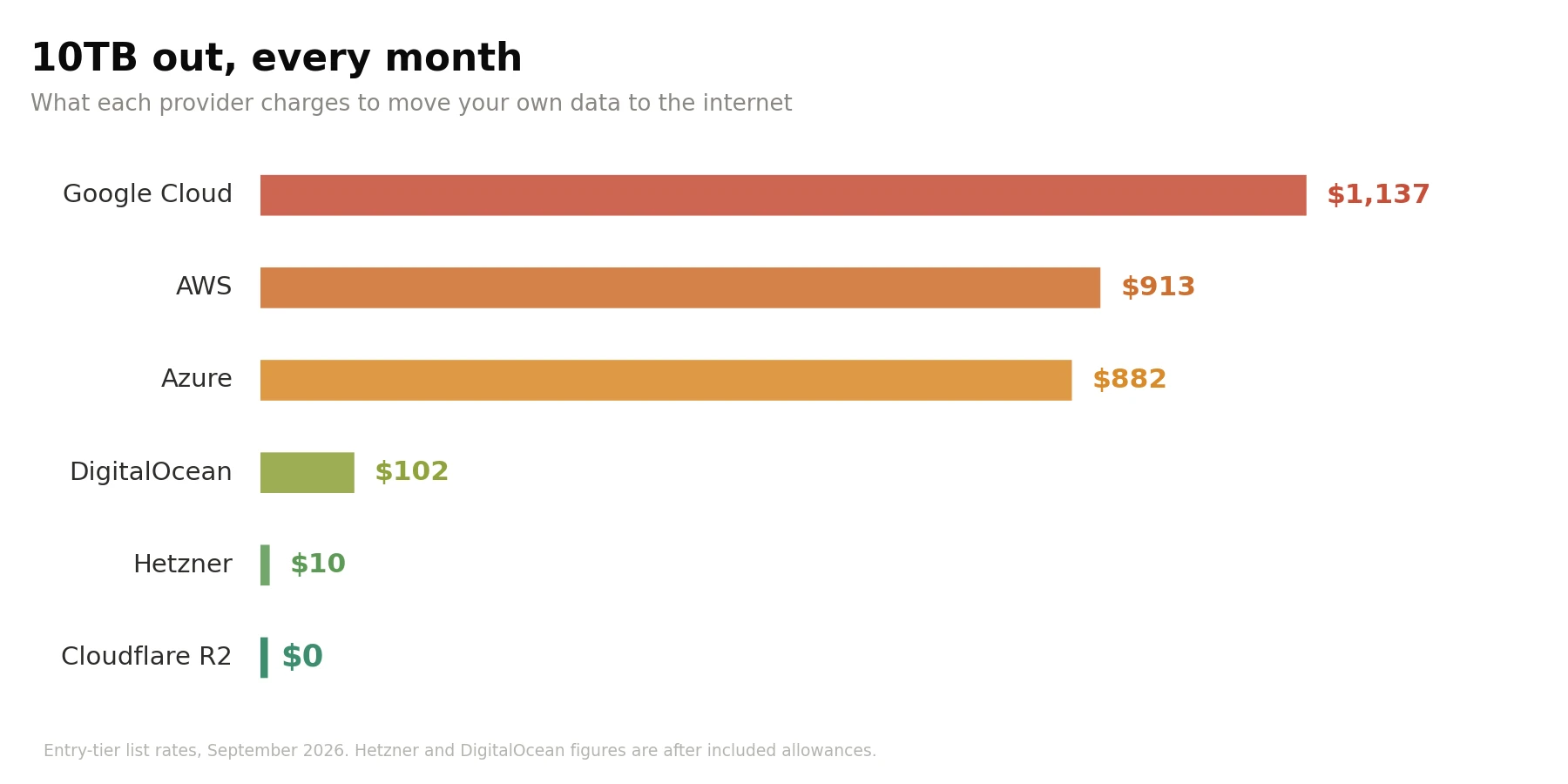 At entry rates in September 2026, AWS charges $0.09 per GB for the first 10TB a month, Azure $0.087, and Google Cloud $0.12 on its premium tier. Cloudflare R2 charges nothing, at any volume. Hetzner includes 20TB per server and charges around $0.001 per GB beyond that. DigitalOcean is around $0.01.
I ran that for a realistic workload. Ten terabytes leaving each provider every month costs roughly $913 on AWS, $882 on Azure, $1,137 on Google Cloud, and $0 on Cloudflare R2.
Same data. Same month. I make that a difference of over a thousand dollars.
AWS and Azure both include a 100GB a month free tier for egress, and AWS tiers downward with volume, dropping to $0.085 after 10TB and $0.05 above 150TB. None of that closes a gap this size.
There are also charges I did not see coming. On AWS, NAT Gateway processing runs around $0.045 per GB on top of standard egress, cross-availability-zone transfer is about $0.01 per GB in each direction, and load balancer data processing adds roughly $0.008 per GB.
I am not arguing that Cloudflare or Hetzner is right for everyone. The hyperscalers sell a far deeper catalogue and the egress premium partly funds a global network. But if your workload serves a lot of data to the public internet, egress will be a bigger line on your bill than compute, and no definitional article will have warned you.
Which Cloud Computing Services You Actually Need
A small website or app with low traffic. A single VPS from Hetzner, DigitalOcean or Vultr. In my view you do not need a hyperscaler and you will pay several times more if you use one.
A startup shipping product fast. PaaS. Render, Railway, Fly.io or App Engine. You buy back the time you would spend on servers, which at that stage is the scarcest thing you have.
A business moving existing servers off-premises. IaaS, usually on a hyperscaler, because the migration tooling and the enterprise support are there.
Anything serving large files, video or downloads. Check egress and CDN bandwidth before you check anything else, because latency and transfer cost will dominate. Zero-egress storage such as Cloudflare R2 or Backblaze B2 pairs well with compute elsewhere.
Regulated data. Private or hybrid, and the decision is driven by your compliance obligations rather than by price. Whichever you pick, securing what you put in the cloud is your job rather than the provider's, which is a separate buying decision I covered in this guide to cloud security services.
A company already deep in Microsoft tooling. Azure, for integration reasons that outweigh per-unit pricing.
The Questions Behind the Definitions
What are cloud computing services?
Computing resources rented over the internet rather than owned: servers, storage, databases, networking and software, billed on consumption.
What are the 3 types of cloud computing services?
Infrastructure as a Service, Platform as a Service and Software as a Service. Some vendors count serverless as a fourth, though it sits inside PaaS.
What is the difference between IaaS, PaaS and SaaS?
How much you manage. IaaS gives you raw infrastructure, PaaS gives you a place to deploy code, SaaS gives you a finished application.
What are the 4 deployment models?
Public, private, hybrid and multicloud. Community cloud is sometimes counted as a fifth.
Who are the biggest cloud computing providers?
AWS, Microsoft Azure and Google Cloud, holding roughly two thirds of the market between them, followed by IBM, Oracle and Alibaba.
How much do cloud computing services cost?
It depends on four meters: compute, storage, operations and data transfer. A small VPS starts a few dollars a month. Hyperscaler bills scale with usage and commitment discounts.
What are egress fees?
Charges for data leaving a provider's network. Entry rates run from $0 on Cloudflare R2 to $0.12 per GB on Google Cloud premium tier.
Is the total cost of cloud lower than owning servers?
At small scale and variable load, usually. At large, steady, predictable load, often not, which is why cloud repatriation exists as a trend.
What is serverless computing?
Code that runs on demand with no server to manage, billed per execution and scaling to zero when idle. AWS Lambda and Cloudflare Workers are the common examples.
Do I need a hyperscaler?
Most small teams do not. The catalogue depth of AWS or Azure matters at scale and costs you money before then.
The Thing That Decides How Free You Are
One last point, because I think it connects the two halves of this article.
The service model you choose decides how hard it will be to leave. IaaS is the easiest to move, because a virtual machine is close to portable. SaaS is the hardest, because your data lives in someone else's schema. PaaS sits between, depending on how many provider-specific services you wired in.
Egress is what you pay to act on that freedom. Moving a few terabytes out of a hyperscaler costs real money, which is precisely why the fee exists at that level and why the challengers set it to zero.
So when someone tells you cloud computing services are about flexibility, I would say that is true of the technology and only partly true of the commercial arrangement. The flexibility is real. The exit has a price list.
I would want to know that before picking, rather than at the point of wanting to leave.
Egress rates and provider pricing in this article were checked against published rate cards and pricing comparisons in September and October 2026. Cloud pricing changes frequently and varies by region, so confirm the figures for your own workload before budgeting.