

When you pay rent with a Bilt Card, the money never touches your credit line.
That surprises almost everyone, and I think it is the single most important thing to understand about how Bilt Rewards works today. Bilt debits the rent straight from your linked bank account, usually within 24 hours, and awards the points separately.
So your rent does not increase your card balance, does not affect your credit utilisation, and does not sit on an interest-free float until the statement is due. It is a bank transfer that happens to earn points.
This is new. The Bilt Rewards program changed on 7 February 2026 under the relaunch people call Bilt 2.0, and most guides explaining how does the Bilt card work still describe a version that no longer exists.
I am not a financial adviser, so treat this as a description of how the program works rather than advice about whether to apply. Card terms change, so confirm anything here against Bilt's own documentation before you act on it.
How Does Bilt Work Now? What Changed in February 2026
The old Wells Fargo Bilt Mastercard was deactivated on 7 February 2026.
In its place, Bilt launched three new cards: Blue, Obsidian and Palladium. The issuer is Column N.A., and the servicer is Cardless Inc., which Bilt describes plainly as a financial technology company rather than a bank.
So if you read a guide describing a five-transaction rule per statement period, or 3X on dining and 6X on Lyft, I can tell you it is describing a card that no longer exists.
What Is Bilt Rewards, and How Do You Earn Bilt Points Without a Card?
You do not need a Bilt Card to use Bilt.
Bilt Rewards is a free membership, and I would start there before applying for anything. If you live in a Bilt Alliance property, you can pay rent through the Bilt app using a linked bank account and earn points. Members without a Bilt Card typically earn at a lower rate, around one point per dollar for every two dollars spent, on rent and HOA fees paid through supported portals. That is the simplest answer to how to earn Bilt points with no card at all.
All members also earn through Bilt's Neighborhood partners, which are local restaurants, gyms and pharmacies where linked cards earn extra points.
And every member, card or not, earns $50 in Bilt Cash at each 25,000 point milestone toward elite status.
What If Your Landlord Is Not a Bilt Partner?
This is the question I see asked most, and I think the answer is better than people expect.
If your building is not in the Bilt Alliance, or your mortgage is not serviced by UWM, you use BillPay inside the Bilt app. Bilt will pay your landlord through a third-party portal, through Venmo or PayPal, or by posting an actual paper cheque on your behalf.
So you can use Bilt even if your landlord has never heard of it. I would just expect to route the payment differently.
The Two Reward Settings, and Why the Default Matters
Here is the part that decides how many points you earn, and in my view the part that is easiest to get wrong.
Every Bilt cardholder must choose between two bonus reward options, and I would make that choice deliberately rather than clicking through it. If you do not choose, Bilt defaults you to Housing-only.
Housing-only rewards. You earn points on your rent or mortgage automatically, at a multiplier set by how much you spend on everyday purchases during the same billing cycle.
Flexible Bilt Cash. You earn 4% back in Bilt Cash on everyday spending instead, then redeem that Bilt Cash to unlock points on housing at a rate of $30 of Bilt Cash for 1,000 points, up to 1X.
You can switch once during your first statement period with immediate effect. After that, any change only takes effect in the following billing cycle. So the setting you ignore at signup is the one I would expect you to live with for a month.
One catch on the Bilt Cash route that I did not expect: when you redeem, you must redeem your entire available Bilt Cash balance. It is not a partial redemption.
How the Housing Multiplier Actually Works
If you pick Housing-only, I would not assume your rent multiplier is fixed. It is recalculated every billing cycle by comparing your everyday card spending against your housing payment.
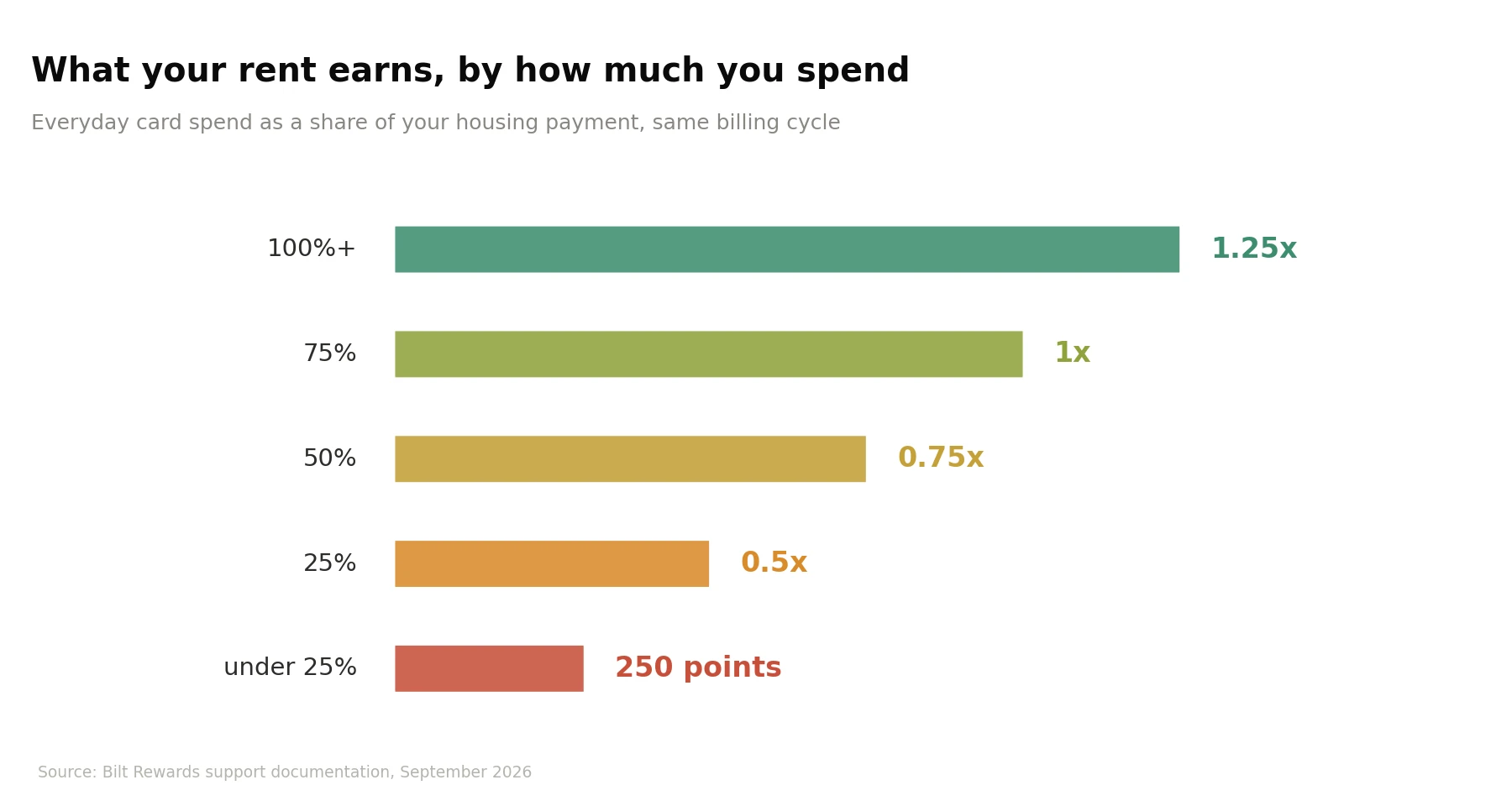 From Bilt's own support documentation:
Spend at least 25% of your housing payment on everyday purchases, earn 0.5X on housing
Spend at least 50%, earn 0.75X
Spend at least 75%, earn 1X
Spend 100% or more, earn 1.25X
Spend below the first threshold and you still get a floor of 250 points
Every published guide I read mentions only the 75% and 100% tiers. There are four, and the two lower ones matter to anyone with high rent and modest spending.
Bilt gives its own worked example, and I would run yours the same way. A $2,000 rent payment with $1,500 of everyday spend in the same cycle hits 75%, so you earn 1X, meaning 2,000 points, credited after the statement closes.
I would notice what that implies. On a $2,500 rent, reaching 1.25X means spending $2,500 on everyday purchases that month. For most renters I do not think that is realistic, which is why the middle tiers are the ones that will actually apply to you.
One genuinely useful detail almost nobody mentions: authorized user spending counts toward the same threshold. Bilt combines everyday spend across the primary cardholder and all authorised users when calculating the ratio. If you live with a partner, I would put shared spending on one account to lift the multiplier for the whole household.
The Three Bilt Cards and Their Points Per Dollar
All three earn points on rent and mortgage with no transaction fee, and all three offer both reward settings, so I would choose on annual fee and everyday categories rather than on the housing rate.
Bilt Blue. No annual fee. 1X points on everyday purchases. No authorised user fee.
Bilt Obsidian. $95 a year. You pick either dining or grocery as your 3X category for the year, with grocery capped at $25,000 of spend. 2X on travel, 1X on everything else, plus a $100 annual hotel credit paid semi-annually. Authorised users cost $50 each.
Bilt Palladium. $495 a year. 2X on everyday purchases, $200 of annual Bilt Cash, a $400 hotel credit paid semi-annually, and Priority Pass lounge access. Authorised users cost $95 each.
You can only hold one Bilt Card at a time. Upgrades between them went into beta in September 2026, and when available they do not require a new application or a hard credit check, with one product change allowed per twelve months.
Rent Day Does Not Apply to Rent
The name is misleading, and I have seen it trip people up.
Rent Day runs on the 1st of every month and gives double points on everyday purchases. Housing payments are explicitly excluded, and the bonus is capped at 1,000 extra points a month.
So on the Blue Card you earn 2X on normal spending that day, on Obsidian you get 6X on your chosen dining or grocery category, and on Palladium 4X on everyday purchases. Your rent earns exactly what it would have earned anyway.
What Bilt Points and Bilt Cash Are Worth, Bilt Rewards Explained
These are two separate currencies and I would keep them firmly apart.
How Do Bilt Points Work?
Bilt Points transfer at roughly 1:1 to airline and hotel transfer partners, which is where most of the value sits. The transfer chart includes World of Hyatt, Alaska's Atmos Rewards, United and Flying Blue, and unusually for a flexible currency, American Airlines.
Bilt Cash is a straight dollar-for-dollar currency used inside the Bilt ecosystem at partner merchants, or converted to housing points at $30 per 1,000.
The catch I would watch on Bilt Cash is expiry. It runs out at the end of the calendar year, and only $100 carries into the next one. Points do not work that way, so a large Bilt Cash balance in November is a use-it-or-lose-it problem.
Does Bilt Help Your Credit?
Bilt includes free credit reporting on every on-time rent payment, which is a real benefit for anyone with a thin file.
The 2026 structure adds a second benefit I had not considered. Because rent is pulled from your bank account rather than charged to the card, a $2,000 rent payment does not inflate your reported balance or your credit utilisation. Under the old card it did.
Two things I would check on the card side. Credit line increases are not currently available on the new cards. And there is a 10% introductory APR for the first twelve billing cycles, after which a variable rate in the mid-twenties to mid-thirties applies, so I would not carry a balance on it.
Short Answers on How Bilt Works
How does Bilt Rewards work in simple terms?
You pay rent or mortgage through the Bilt app, Bilt debits your bank account to cover it, and you earn points. There is no transaction fee. A Bilt Card increases what you earn but is not required.
Do I need a Bilt credit card?
No. Membership is free and you can earn on rent without a card, usually at a lower rate. The card raises the earning rate and adds everyday spending rewards.
Does Bilt charge a fee to pay rent?
No. Bilt states that cardholders are never charged a transaction fee on housing payments, whichever reward setting they choose.
How many points do I get for paying rent?
Between 250 points and 1.25X your rent, depending on your reward setting and how much you spend on the card that cycle.
What happened to the Wells Fargo Bilt Mastercard?
It was deactivated on 7 February 2026 and replaced by three cards issued by Column N.A.
Does my landlord need to be a Bilt partner?
No. If your building is not in the Bilt Alliance, BillPay will pay by portal, Venmo, PayPal or paper cheque.
Does rent go on my credit card balance?
No, not since the 2026 change. It is pulled from your linked bank account within 24 hours and does not use your credit line.
Can I carry my rent payment as a balance?
No. That option disappeared with the old card, along with the float between paying rent and the statement being due.
Does Bilt work for mortgage payments?
Yes. Every card earns on mortgage as well as rent, and you can earn on both at once if you rent one property and own another.
Is there an annual fee?
Blue has none. Obsidian is $95 and Palladium is $495, plus per-authorised-user fees of $50 and $95 respectively.
Does Bilt build credit?
On-time rent payments are reported to credit bureaus at no cost, and the card reports like any other credit card.
Where Bilt Does Not Work
Three situations where I would not bother, and I have not seen any of the guides say so.
You want the float. If the appeal was paying rent on credit and settling it three weeks later, that is gone. Rent leaves your bank account within a day now.
Your everyday spending is low relative to your rent. Someone paying $2,400 rent who spends $400 a month on cards lands under the first threshold and collects 250 points. That is not a rewards strategy, it is a rounding error.
You would carry a balance. The intro rate lasts twelve billing cycles. After that the variable APR runs well above twenty percent, and interest swallows any points value immediately.
If what you actually want is better visibility over where the money goes each month, that is a different tool entirely, and I went through the options in this guide to Quicken alternatives.
So is Bilt Rewards worth it? For everyone else, my summary is that Bilt still does something no other card does, which is turn the largest bill most people pay into points without a processing fee. It just does it through your bank account now rather than your credit line.
Program details in this article come from Bilt's own support documentation, read in September 2026. Card terms, fees and partners change, so verify with Bilt before applying.