

Here is the honest answer: How does Tomoson work? It worked as an influencer marketplace. A brand posted a product campaign, influencers and bloggers applied for free, the brand approved the ones it liked and shipped the product or sent a coupon code, and the influencer posted an honest review or social media post. Tomoson then checked the submitted links. Brands paid a monthly subscription from $49 to $599. But when we tested tomoson.com on November 19, 2026, every sign-up and free trial button looped back to the same page, and the site now runs as a blog. So for new users today, it does not work at all.
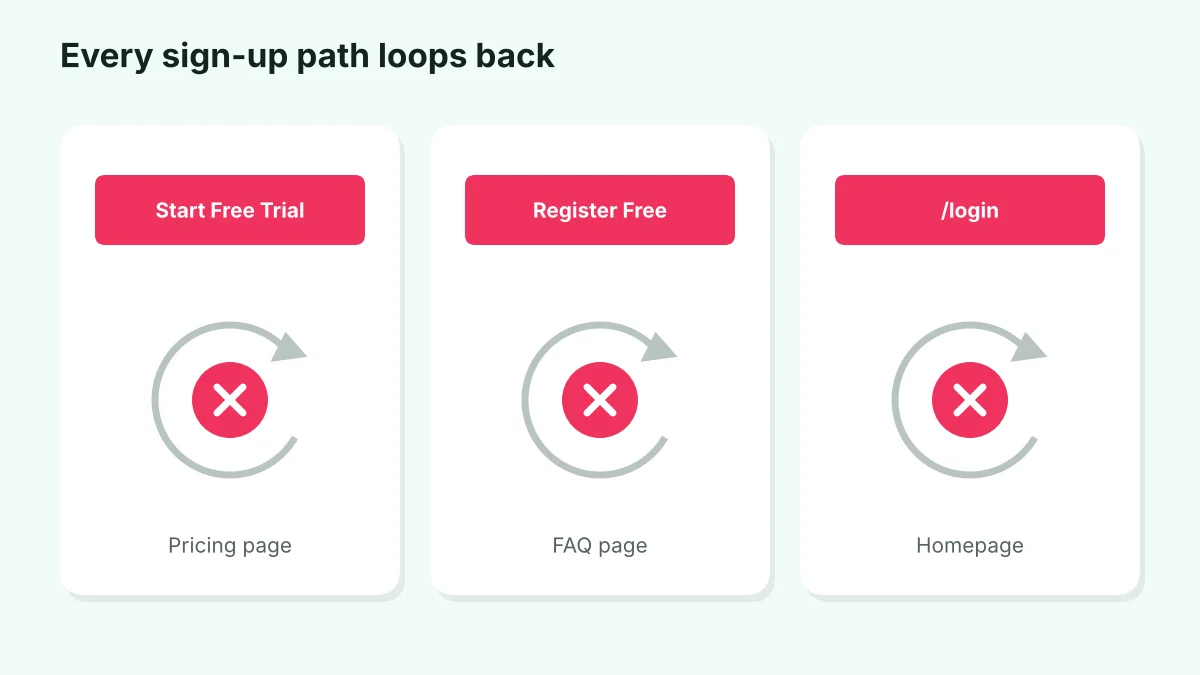
I clicked the pink "Start Your 21 Day Free Trial" button on Tomoson's pricing page and waited. The page reloaded and dropped me back at the top of the same pricing table. I tried the influencer "Register Free" button next. Same thing.
That is the part most "how does Tomoson work" articles leave out. Many of them were written years ago, or they are posts on tomoson.com itself describing a platform you can no longer join.
So in this guide, we do three things. First, we show you what we found when we tested the site ourselves. Second, we explain exactly how Tomoson's workflow ran for brands and for influencers, using Tomoson's own FAQ pages, which are still online. Third, we show you which platforms run the same kind of product seeding campaign today.
What Is Tomoson?
Tomoson is an influencer marketing platform that connected brands with bloggers, social media influencers and micro-influencers. Jeff Foster was its co-founder and CEO. The platform let content creators get paid or get free products for sponsored content, and it let small businesses reach niche audiences.
At its core, Tomoson was an influencer marketplace built around product sampling. A brand would give away a product. In return, creators would write blog reviews, post on social media or leave reviews on certain third-party sites.
What Does Tomoson Do?
Tomoson did four main jobs:
Influencer discovery: brands set campaign requirements, and qualified creators came to them by applying.
Campaign management: a campaign dashboard showed applications, approvals, shipments and completed work.
Communication: an Invite System and a Message Center kept all brand and creator talk inside the platform.
Review verification: Tomoson checked that submitted posts were real, linked to the right product and were not copied from the brand's website.
Its later "Tour" page also describes a content tool that gathered branded content and let brands repost it to their social pages. So by the end, Tomoson was part influencer marketplace and part social content tool.
Who Should Use Tomoson?
Tomoson was built for small businesses, ecommerce stores and product brands that wanted user-generated content (UGC), product reviews and social proof without big influencer fees. On the creator side, it suited bloggers and micro-influencers who wanted free products to review.
Today, nobody should plan around it. If you are a brand, use one of the alternatives further down. If you are an influencer, put your time into platforms where you can actually register.
Is Tomoson Still Working? I Tested It in November 2026
I spent about an hour on tomoson.com on November 19, 2026. I wanted to see if a brand or an influencer could still sign up and run a campaign. Here is what happened.
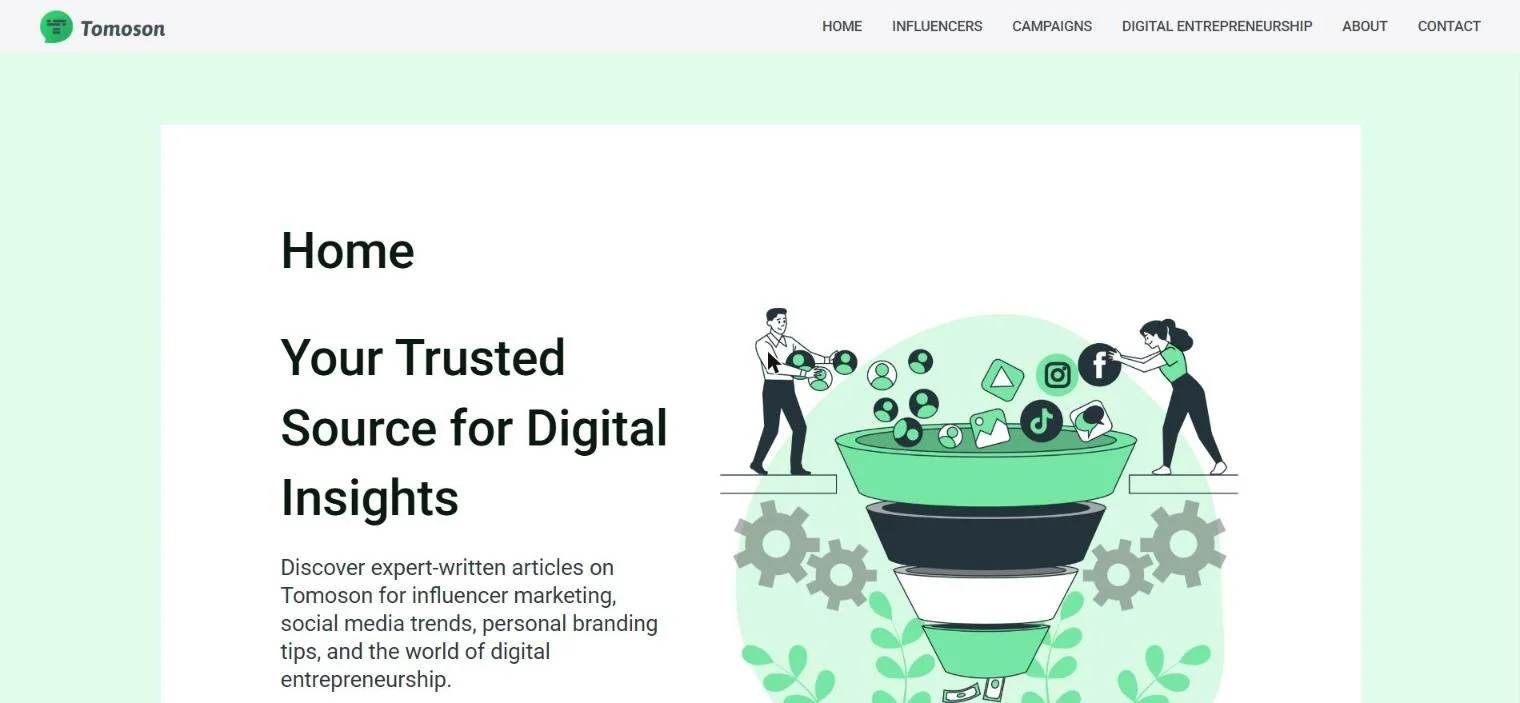
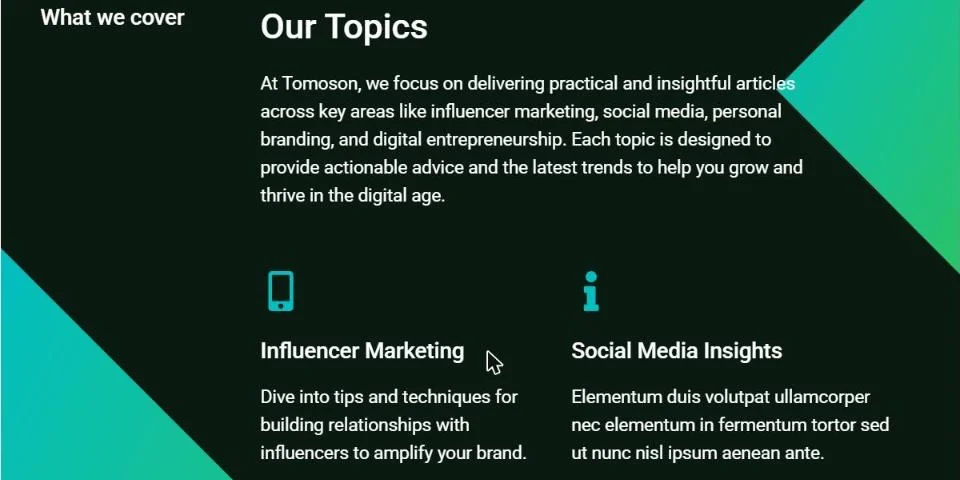
The homepage no longer looks like a software product. It says "Your Trusted Source for Digital Insights" and lists blog articles about influencer marketing, personal branding and digital entrepreneurship. There is no login button and no sign-up button in the menu.
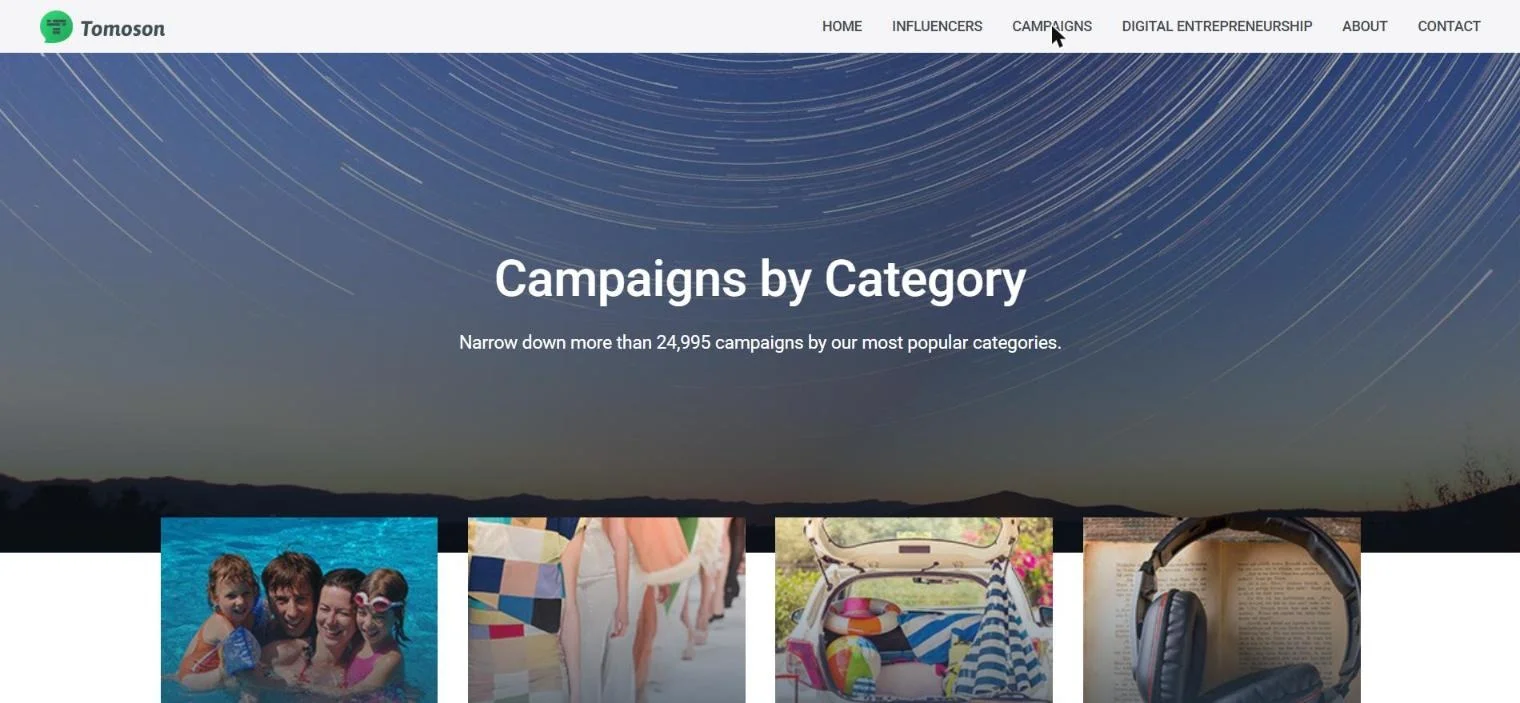
 The Campaigns page says you can narrow down more than 24,995 campaigns by category. I tried to click Family, Beauty and other categories. They are pictures with labels, not links. There are no campaigns to open.
 Next, I opened the Pricing page from the footer. The plans are still listed, from Basic at $49 a month to Scale at $599 a month. Under them is a big "Start Your 21 Day Free Trial" button. Clicking it just reloads the pricing page.
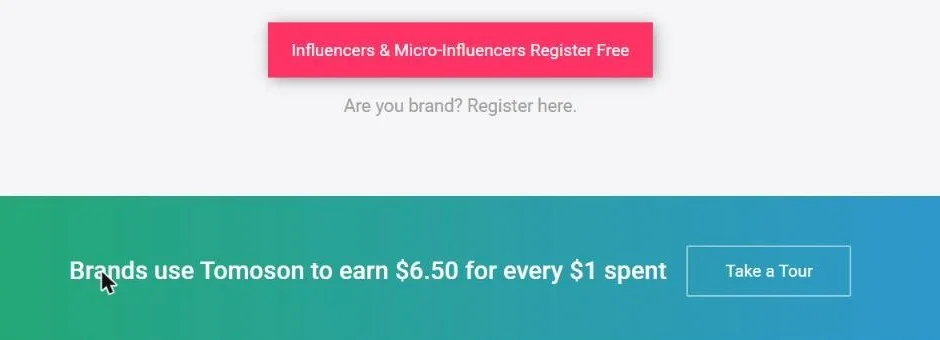
 On the FAQ pages, there is an "Influencers & Micro-Influencers Register Free" button. Clicking it reloads the FAQ. Under it, "Are you brand? Register here." is plain text, not a link.
 I also typed the old addresses for the login and sign-up pages directly. Both sent me back to the homepage.
What I tried | What happened |
|---|---|
Start Your 21 Day Free Trial (brands) | Reloaded the pricing page |
Influencers Register Free | Reloaded the FAQ page |
"Are you brand? Register here." | Plain text, not clickable |
tomoson.com/login | Redirected to the homepage |
tomoson.com/signup | Redirected to the homepage |
Campaign categories | Images only, no campaigns behind them |
Contact page | A form and an email address still show |
 One more detail stood out. On the homepage, the "Social Media Insights" topic box is filled with placeholder Latin text, the kind web designers use before real copy is written. That is not something an active software company leaves on its front page.
 Other people have noticed the same thing. EzUGC reports that Tomoson's marketplace has stopped working and that its apply buttons send you back to the homepage. A tech blog that looked into the site in August 2026 also describes tomoson.com as mostly blog content now.
I could not find an official shutdown notice or a date. So my advice is simple: do not pay for any Tomoson plan or promo code you see advertised, and do not hand over account details to any page claiming to be the Tomoson login.
How Does Tomoson Work for Brands? Step by Step
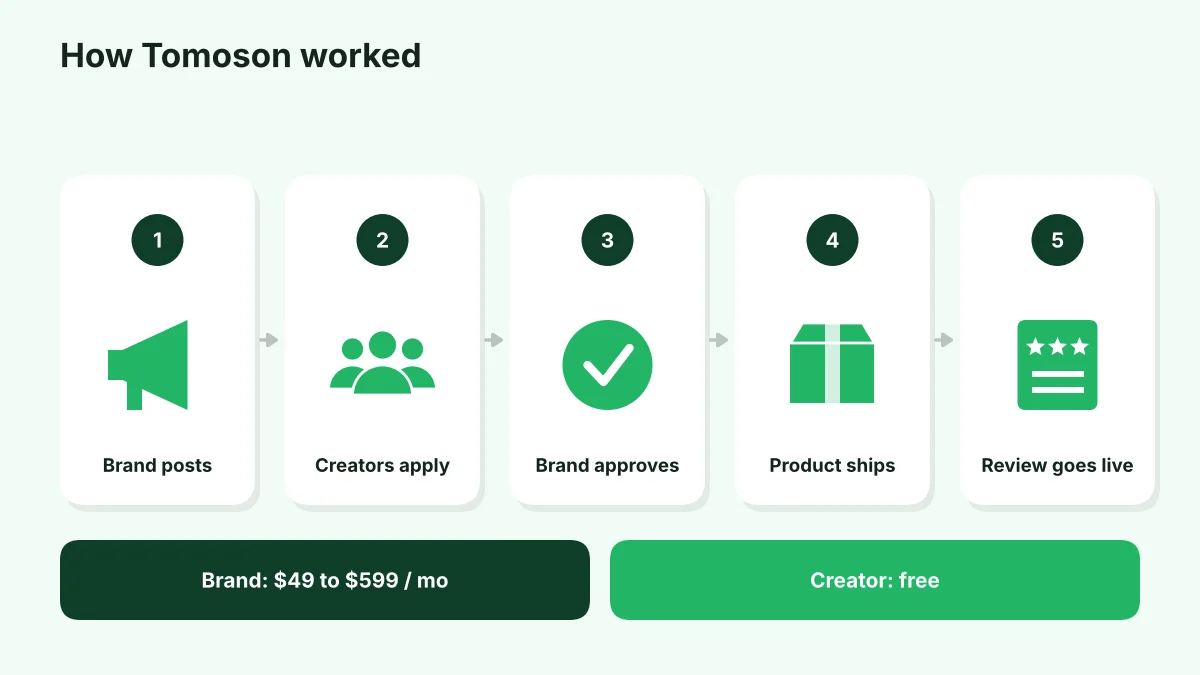 Even though you cannot sign up now, the workflow is worth understanding. Every product seeding platform today works in a similar way. Here is how Tomoson ran it, based on its own brand FAQ.
Step 1: Create a Brand Account
A brand registered, picked a plan and started a free trial. Tomoson limited free trials to one per brand and a maximum of 10 campaigns. Making a second account, or creating more than 10 campaigns during the trial, could get your account suspended.
Step 2: Set Up an Influencer Campaign
Next, the brand created a marketing campaign. Campaign creation meant writing:
What the product is and how it will be provided (shipped free, or a coupon code).
The marketing goal, such as blog reviews, social media posts or feedback on third-party sites.
Campaign deliverables and campaign deadlines.
Prerequisites, like the minimum number of followers, website visitors or a blog niche.
The prerequisites also worked as a block list. Brands could set rules that kept certain people from applying.
Then Tomoson's team approved the campaign by hand. The FAQ says this normally took about 24 business hours. A campaign submitted on a Friday would usually wait through the weekend.
Step 3: Let Influencers Apply
Once approved, the campaign went live in the influencer marketplace. Creators who met the prerequisites could send campaign applications. Brands could also use the Invite System to send brand invitations to specific creators and ask them to apply.
Step 4: Review and Approve Influencers
Every brand could see who applied. Influencers who met the campaign requirements were preapproved, and then the brand made the final influencer selection by hand.
To judge applicants, brands looked at influencer profiles and a number Tomoson called Total Reach. Tomoson calculated it by adding up website visitors, Facebook friends and likes, Twitter followers, YouTube subscribers and Instagram followers.
There was no limit. The FAQ says you could approve as many influencers as you wanted per campaign.
Step 5: Send Products or Provide Compensation
After approval, the brand shipped the product or uploaded a coupon code. Tomoson was strict here. Products had to be new and unused, and for review campaigns they had to be free, including shipping.
The FAQ also reminds brands to plan their marketing budget around more than the subscription. You still pay for the product, the shipping and any payment to influencers for their work. If a shipment was late, brands were expected to extend the influencer's completion time.
Step 6: Review Content and Track Results
When an influencer finished their tasks, Tomoson verified the links. The brand then clicked the Completed button on that campaign in its dashboard to see every review link in one place.
If a post looked fake, the brand could report it. Tomoson treated a task as invalid if:
the influencer clearly did not test the product,
the post was about a different product,
the post was copied from the brand's own website, or
the link was broken or pointed to the wrong site.
For performance tracking beyond that list, most brands used coupon codes, affiliate links and UTM tracking to measure referral traffic and sales. If you run influencer coupon codes today, read our guide to affiliate fraud detection. Leaked codes and fake conversions are a real cost in creator programs.
One thing to know: Tomoson never promised backlinks. Its FAQ says brands could suggest where an influencer links, but linking was not required, because paying for links is against Google's policy.
How Does Tomoson Work for Influencers?
On the influencer side, Tomoson was free. Here is how the process worked.
Create and Complete an Influencer Profile
Influencers signed up for free and connected their blog and social accounts. Tomoson pushed creators to fill out every profile field. Brands wanted to see audience demographics, engagement rate and total reach before saying yes.
Accounts with no connected social accounts, zero Total Reach or too few followers could be locked.
Find Relevant Campaigns
Creators browsed campaigns by category, like Beauty, Food & Drink, Baby, Pets or Electronics. They could also get brand invitations sent directly to them.
Apply for Product Promotions
Creators applied to the campaigns they qualified for. Most products were free, but the FAQ notes that some were offered at a big discount instead. So you had to read the campaign terms before applying.
Complete Campaign Requirements
After approval and delivery, the creator tested the product and created content: a blog review, social media posts, an unboxing video or a product demonstration. Then they submitted the link before the deadline. Late posts hurt the creator's rating.
Tomoson asked for honest reviews. Influencers did not have to say nice things, and Tomoson would not step in if a brand got a negative review. Creators also had to follow FTC rules, which say you must disclose free products and other perks. The FTC's Disclosures 101 guide explains how to do that properly.
Breaking the rules could end your account. Tomoson listed these reasons for suspension:
misusing coupon codes,
not following FTC guidelines,
selling products received for review,
posting fake, copied or non-reviews,
sending spam or messages not related to a campaign.
Tomoson says all suspensions were final.
Key Features of Tomoson
Feature | What it did |
|---|---|
Campaign dashboard | One place to manage campaigns, approvals and completed work |
Campaign prerequisites | Filters for followers, website visitors and niche |
Invite System | Lets brands invite chosen creators to apply |
Message Center | In-platform chat about active campaigns only |
Total Reach | A combined audience number across a creator's channels |
Review verification | Checks that submitted links are real and on the right site |
Third-party reviews | A Feedback campaign goal for sites like Goodreads, Etsy and Home Depot |
Contacts list | Saves favorite creators to invite again |
Content tool | Collects and reposts branded content to social pages |
The Message Center had firm rules. Brands could not ask for emails or addresses, could not send coupon codes there and could not offer to pay creators outside the platform. Tomoson wanted everything to stay on Tomoson.
How Much Does Tomoson Cost?
Influencers paid nothing. Brands paid a monthly subscription after the free trial, and the FAQ says the fee was based on software usage.
 The pricing page, which is still online, lists five plans:
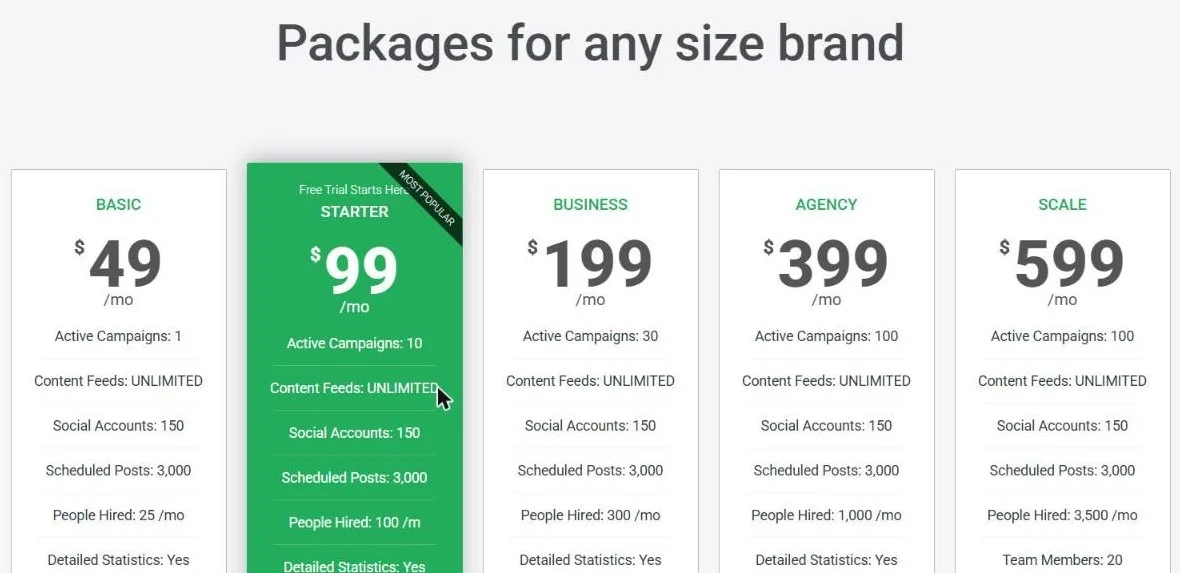
Plan | Price | Active campaigns | People hired per month | Team members |
|---|---|---|---|---|
Basic | $49/mo | 1 | 25 | 1 |
Starter (trial plan) | $99/mo | 10 | 100 | 3 |
Business | $199/mo | 30 | 300 | 5 |
Agency | $399/mo | 100 | 1,000 | 10 |
Scale | $599/mo | 100 | 3,500 | 20 |
Every plan lists unlimited content feeds, 150 social accounts, 3,000 scheduled posts, detailed statistics, engagement reporting, exported reports, and email and chat support.
Again, since the trial button does not work, these prices are history. I would not trust any site selling a Tomoson discount today.
Benefits and Limitations of Tomoson
Benefits (when it worked)
Cheap entry point for small businesses at $49 a month.
Influencers came to you, so there was little cold influencer outreach.
Clear campaign approval process with manual checks.
Honest review rules and review verification.
Free for creators, which kept the supply of applicants high.
Good for blog reviews and UGC, not just Instagram posts.
Limitations
Applicant quality varied a lot. Since anyone with a blog could join, brands had to filter hard. One agency that tested it described a lot of manual work to weed out weak blogs.
Shipping problems hurt everyone. If a product arrived late, creators got deadline warnings and took it out on the brand.
Some users reported Amazon sellers trying to trade free products for 5-star reviews. That broke Tomoson's own rules and Amazon's. Amazon has banned incentivized reviews outside its own Vine program since 2016.
Total Reach simply added up followers and visitors, so it said nothing about fake followers or real engagement.
No ROI tracking built for sales. You needed your own coupon codes or UTM links.
Today, the biggest limitation of all: you cannot sign up.
What Real Users Said About Tomoson
Tomoson reviews from real users are mixed and mostly old. A marketing agency that ran campaigns on it said the open sign-up meant blog quality was what you would expect, but the brand still controlled who got products. The agency also described scammers giving fake Amazon order numbers.
SmartCustomer shows Tomoson at 1.5 out of 5. Complaints there say influencer quality was poor and that many sellers used the platform to trade free products for 5-star reviews.
The pattern is clear. Tomoson could work for a careful brand that filtered applicants well. It did not do that filtering for you.
Is Tomoson Worth Using?
No, because you cannot use it. Every sign-up path we tested loops back to the page you started on, and there is no working login.
But the model is still worth using. Product seeding with micro-influencers is one of the cheapest ways to get honest product reviews, UGC and brand awareness for a small business. You just need a platform that is alive.
If you are a brand, I would pick a platform where:
You can post a campaign and let creators apply, like Tomoson did.
You can see real engagement metrics, not just follower counts.
You can track results with coupon codes or affiliate links.
The pricing is public and there is a free plan or trial you can test first.
If you are an influencer, look for platforms that are free to join and show campaigns before you sign up.
Best Tomoson Alternatives
Platform | Best for | Works like Tomoson? | Starting cost |
|---|---|---|---|
Afluencer | Post a collab, let creators apply | Yes, closest match | Free to post, paid from $49/mo |
Intellifluence | Small test campaigns | Yes | Free plan, paid from $99/mo |
Collabstr | Buying posts at listed prices | Partly | Free tier with a hiring fee |
GRIN | Ongoing product gifting | Partly | Limited free plan, paid from $200/mo |
Creator.co | Brand and creator collaborations | Yes | See pricing page |
Upfluence | Influencer discovery and campaign management | No, search-based | Quote only |
Aspire | Influencer partnerships at scale | Partly | Quote only |
Heepsy | Influencer search and discovery | No, search-based | See pricing page |
HypeAuditor | Influencer analytics and fake follower checks | No | Free tools to start |
Influencity | Influencer campaign management | No, search-based | Free plan available |
Prices change often, so check each site before you commit.
My picks by situation:
You want the same flow Tomoson had: start with Afluencer. You post a collab, creators apply, and you choose who to accept. Its free plan lets you test this without a card.
You want a small test campaign: Intellifluence's free plan covers one campaign, which is enough to see if seeding works for your product.
You care most about fake followers: run shortlisted creators through HypeAuditor before you ship anything.
You are a creator: Afluencer and Intellifluence are free to join, and Collabstr lets you list your own prices.
Frequently Asked Questions
What is Tomoson used for?
Tomoson was used for influencer marketing through product campaigns. Brands gave products to bloggers and social media influencers in exchange for honest reviews, social media posts and other user-generated content.
How does Tomoson work?
A brand created a campaign, influencers who met its requirements applied, the brand approved the ones it wanted, then shipped the product or sent a coupon code. The influencer posted the content, and Tomoson verified the links. In our November 2026 test, though, new users could not sign up.
Is Tomoson free to use?
It was free for influencers. Brands got a free trial, limited to one per brand and 10 campaigns, and then paid a monthly subscription from $49 to $599.
Do influencers get paid on Tomoson?
Mostly they got free products. Some campaigns also offered payment, and Tomoson told brands to budget for paying influencers for their work. Many campaigns were product-only.
Can influencers receive free products through Tomoson?
Yes, that was the main reward. Most products were free, and some were offered at a big discount. Selling those products was against the rules and could get an account suspended.
How do brands find influencers on Tomoson?
Brands set prerequisites like follower count or blog niche, and creators who matched could apply. Brands could also invite specific creators with the Invite System.
How does Tomoson approve campaigns?
Tomoson's team reviewed every campaign by hand before it went live. The FAQ says this normally took about 24 business hours.
Does Tomoson work with bloggers?
Yes. Tomoson was built around bloggers and counted website visitors as part of an influencer's Total Reach. Blog reviews were one of its main campaign types.
Can small businesses use Tomoson?
Small businesses were its main market when it worked, with plans from $49 a month. Today, small businesses cannot sign up, so a live platform like Afluencer or Intellifluence is the better choice.
Is Tomoson worth it for influencer marketing?
Not anymore. The sign-up and free trial buttons loop back to the same page, and the site now runs as a blog. The product seeding model is still worth it, but on a platform that is still active.