

Affiliate fraud detection is the process of checking every affiliate click, lead and sale for signs of fakery before you pay commission on it.
Good detection combines automated scoring (IP, device and behaviour checks) with a payout hold and a human review of anything flagged. Most programs need both a tool and a process, because software alone misses the fraud that only shows up after a refund or chargeback.
That is the whole idea. Now let me show you why it matters, and how to do it properly.
Why I Started Looking at Affiliate Fraud Detection
An affiliate manager I know had a great month on paper.
One new partner sent 400 sign ups in three weeks. Conversion rate was strong. The partner asked for an early payout, and she almost said yes.
Then she looked closer. Most of the "customers" used the same few devices. Half had cancelled within 48 hours. The rest never logged in once.
She had not found a star partner. She had found a leak.
That story is common, and it is the reason I wrote this. If you run an affiliate program, you are the person who signs off on payouts. That makes fraud your problem, whether your job title says so or not.
Vendor reports I read this year put affiliate fraud losses somewhere between 8% and 17% of total affiliate spend, depending on the vertical. Even at the low end, that is marketing budget waste sitting right inside your own payouts.
So let me walk you through how affiliate fraud detection works, what the fraud looks like, and which affiliate fraud detection solutions are worth your budget.
What Is Affiliate Fraud Detection?
Affiliate fraud detection is software plus process that finds commissions you should not pay.
The software side looks at every event in your affiliate tracking and conversion tracking, from the first click on an affiliate link to the final sale. It checks signals like IP address, device, timing and behaviour, runs a quick risk assessment, and gives each event a fraud score.
The process side decides what you do with that score: approve, hold, reject, or send to manual review.
Here is the part I think most guides skip. Affiliate fraud is different from regular ad fraud because the fraud sits inside the payment itself.
In paid search, a fake click wastes a few dollars. In affiliate marketing, a fake conversion triggers a commission the advertiser pays to the publisher, often $50 or $200 a time. So affiliate marketing fraud prevention has to check the conversion, not just the click.
I find it easiest to think of it like a shop till. Click fraud detection watches who walks through the door. Affiliate fraud detection checks the receipt before the cash leaves the drawer.
Common Types of Affiliate Marketing Fraud
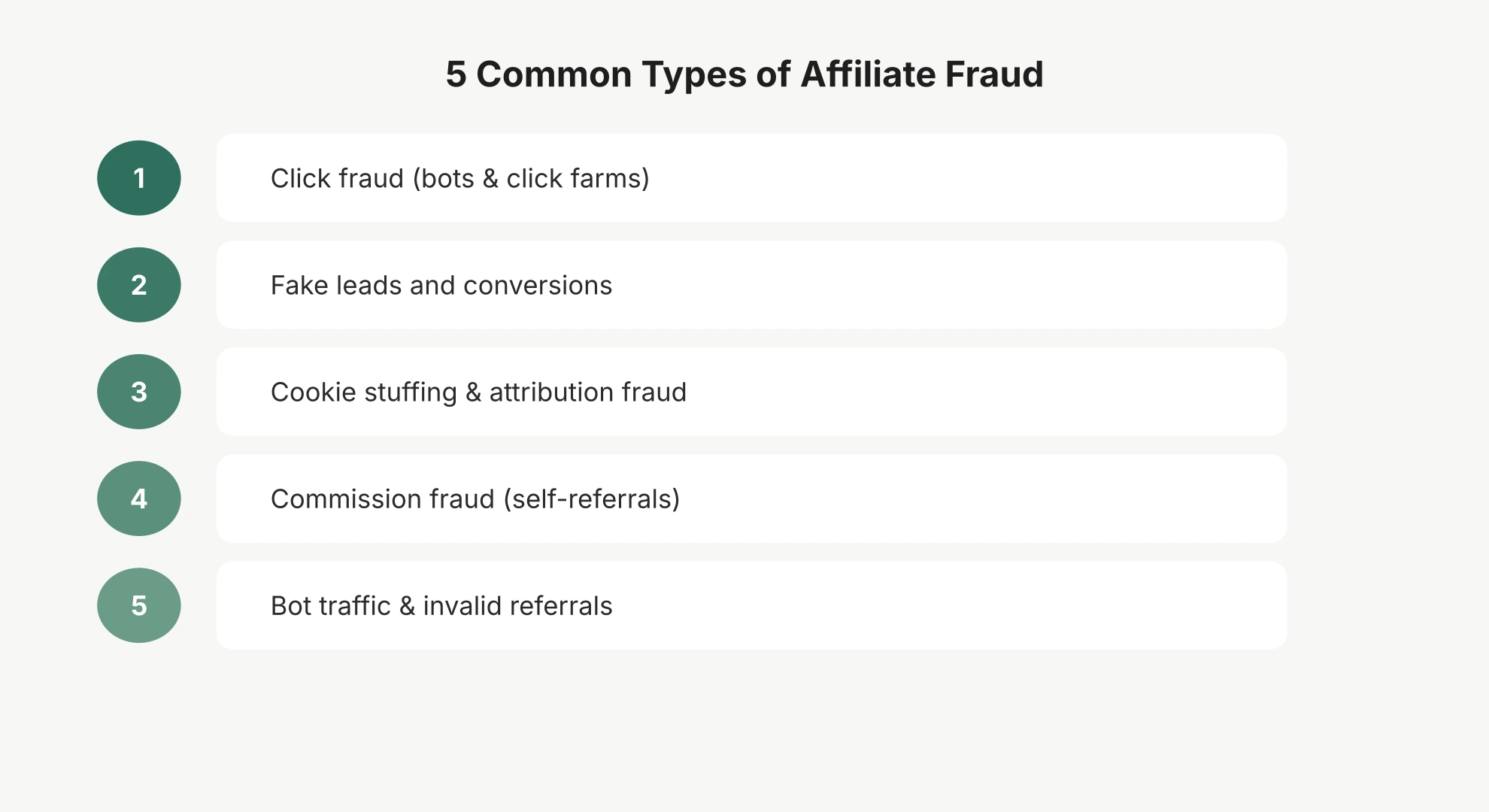 The five fraud types that show up most often in affiliate programs.
Before you pick a tool, I want you to know exactly what you are trying to catch. These are the five patterns that affiliate marketing fraud detection is built to catch.
Click Fraud
Click fraud is fake clicks on affiliate links, usually from bots or click farms. It fills your referral traffic with visitors who were never going to buy. On its own it hurts programs that pay per click. It also pollutes your marketing analytics, so your conversion rate and traffic quality numbers stop meaning anything.
If you want to know how to identify fraudulent affiliate clicks, look for volume without engagement. Thousands of clicks, near zero time on page, and no one scrolling.
Fake Leads and Conversions
This is the big one for lead gen and SaaS trial programs. A fraudulent affiliate submits fake leads using made up names, disposable emails, or stolen details. In ecommerce, it can be purchases with stolen cards that later turn into chargebacks.
Conversion fraud often looks great at first. The sign up count is high and the commission is paid. The damage only shows up weeks later when none of those "customers" ever pay you. That is why tools to detect fake affiliate conversions matter more than click filters for most programs.
Cookie Stuffing and Attribution Fraud
Cookie stuffing is the most common form of affiliate tracking fraud. It is when an affiliate drops their tracking cookie on a visitor's browser without the visitor ever clicking their link. Click injection is the mobile cousin, where an app fires a fake click right before an install completes.
Either way, the affiliate steals credit for a sale they did not drive. This is attribution fraud.
You end up paying commission on a customer who would have bought anyway, or one that another partner actually sent. It quietly pushes up your customer acquisition cost and makes your affiliate attribution data unreliable.
Good affiliate attribution fraud detection looks at the whole click path, not just the last click before the sale.
Commission Fraud
Affiliate commission fraud covers partners gaming the payout rules themselves. The classic version is self referral, where an affiliate buys through their own link to pocket the commission, then refunds.
Others commit account fraud by creating duplicate accounts, send fraudulent referrals, trigger duplicate conversions, or abuse incentivized traffic by paying people to sign up and leave.
This is where commission leakage happens slowly, one payout at a time.
Bot Traffic and Invalid Referrals
The industry splits invalid traffic into two groups. General invalid traffic (GIVT) is simple stuff like known crawlers and data center IPs. Sophisticated invalid traffic (SIVT) is bots that act human, hijacked devices and malware. The IAB and MRC invalid traffic guidelines define both groups, and most serious affiliate fraud detection software follows that split.
GIVT is easy to block. SIVT is where you need real tooling.
How Does Affiliate Fraud Detection Work?
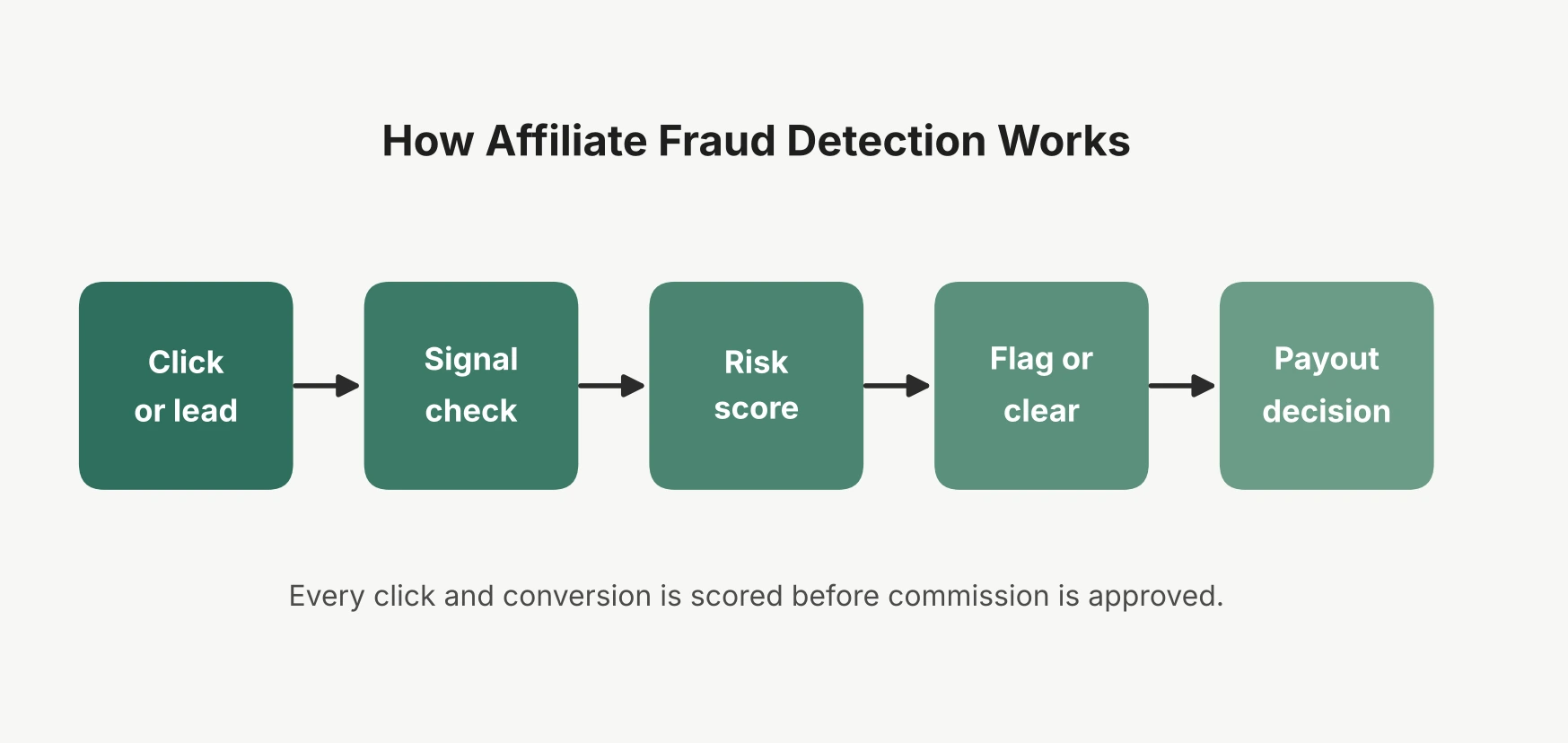 Every click and conversion gets scored before a single commission is approved.
Every decent affiliate fraud detection system follows the same five steps. I have mapped them in the graphic above. The tools differ in how deep each step goes.
1. Capture the event. A click, lead or sale comes in through your affiliate tracking or postback.
2. Check the signals. The system runs IP address analysis (is it a data center, VPN or proxy?), device fingerprinting (has this device converted 30 times already?), and behavioral analysis (did the "user" move the mouse, scroll, or fill the form in under one second?).
3. Score the risk. Fraud detection algorithms combine those signals into a fraud score. Better tools use anomaly detection, comparing each affiliate partner against their own history and against the rest of your program.
4. Flag or clear. Low risk events pass. High risk events get blocked. The middle band goes to manual review, with suspicious activity alerts sent to your team.
5. Decide the payout. This is the step that matters most for affiliate programs. Commissions on flagged events are held, reversed, or clawed back.
Real-time affiliate fraud detection handles steps one to four in milliseconds. This is the real time monitoring part. Step five is where your process and your affiliate terms come in. A tool can tell you a lead is fake. Only your payout rules stop you paying for it.
Best Affiliate Fraud Detection Software
Most lists of the best affiliate fraud detection tools mix three very different kinds of product without telling you. That is why buyers end up with the wrong tool.
So before any affiliate fraud detection software comparison, I group them by type.
Dedicated fraud tools are software to detect fraudulent affiliate traffic and nothing else. They focus on traffic quality analysis and fraud scoring, and plug into your existing tracker.
Affiliate platforms with built in fraud controls handle affiliate program fraud detection alongside tracking, payouts and partner management.
Broader invalid traffic platforms protect paid ads, forms and affiliate traffic in one place.
Here is how the six names I looked at line up. Pricing for all six is quote based, so I have not listed numbers I cannot verify.
Tool | Type | Main strength | Best for |
|---|---|---|---|
Anura | Dedicated fraud tool | Real versus fake verdict on clicks and leads | Lead gen and CPL programs |
TrafficGuard | Dedicated fraud tool | Click fraud and invalid traffic across channels | Programs running affiliate plus paid search or apps |
CHEQ | Broader invalid traffic platform | Blocking bots across ads, sites and forms | Larger marketing teams protecting several channels |
Affiliate platform | Partnership management with fraud and compliance controls | Brands wanting one platform for the whole program | |
Everflow | Affiliate platform | Tracking plus fraud rules and partner level reporting | Performance teams and networks |
Trackier | Affiliate platform | Tracking and campaign analytics with fraud prevention features | Agencies and networks on a tighter budget |
Anura
Anura is an ad fraud tool built around one question: is this a real person or not? It checks clicks and leads and returns a clear verdict. I would pick it for programs that pay per lead, because lead fraud is its main focus. You still need your tracker to act on its verdicts.
TrafficGuard
TrafficGuard covers affiliate traffic fraud detection alongside click fraud on paid search and mobile app installs. If your affiliate program sits next to a big Google Ads budget, one tool for both makes sense. It is less focused on the payout and clawback side.
CHEQ
CHEQ is broader than affiliate. It blocks bots and fake users across your ads, website and forms. That is useful if your problem is fake traffic everywhere, not just from partners. For a pure affiliate program, it may be more than you need.
Impact.com
Impact.com is a full partnership management platform. Fraud and affiliate program compliance controls sit inside the same place you recruit partners, track conversions and pay commissions. The upside is one system. The downside is that its fraud features are one part of a big platform, not its main focus.
Everflow
Everflow is an affiliate tracking platform popular with performance marketers. You can set fraud rules, cap conversions, block sources, and see quality per affiliate partner. It works well when you want affiliate fraud monitoring baked into daily reporting.
Trackier
Trackier offers affiliate tracking and campaign analytics with fraud prevention built in. It tends to suit agencies and networks that want tracking and basic protection without enterprise pricing. For heavy SIVT, you may want to pair it with a dedicated tool.
If your affiliates also bid on your brand name, that is a different problem from fake traffic. I covered the difference in brand protection vs click fraud tools, and it is worth reading before you buy anything.
Essential Features of Affiliate Fraud Detection Tools
When I compare affiliate fraud prevention software, these are the features I check, in this order.
Conversion validation, not just click scoring. The tool must score the lead or sale. Click-only scoring misses the most expensive fraud.
Per affiliate reporting. You need to see fraud scores by partner, not just a program total. Fraud almost always clusters in a handful of affiliates.
Payout hold and clawback support. Look for a way to hold or reverse commissions on flagged events, either inside the tool or through your tracker. This is what separates affiliate commission fraud detection tools from plain click filters.
Device fingerprinting and IP checks. These catch duplicate accounts and self referrals that simple cookie tracking misses.
Clear reasons for each flag. If a tool says "fraud" without saying why, you cannot defend the decision when an affiliate pushes back. Transparency protects your partner relationships.
Adjustable thresholds. False positives are real. Blocking a good partner costs you revenue too. You want to tune the rules, not live with a black box.
Integration with your tracker. An affiliate fraud detection platform that does not talk to your affiliate networks or conversion tracking creates manual work you will not keep up with.
How to Detect Affiliate Marketing Fraud Yourself: A 7 Day Audit
You do not need software to find out whether you have a problem. Here is a quick audit I recommend before buying anything. Export the last 90 days of affiliate data and check these red flags.
Red flag | What to look at | Why it matters |
|---|---|---|
Conversion spikes | A partner whose volume jumps 3x or more in a week | Sudden scale is the top sign of bought or fake traffic |
Very fast conversions | Time from click to conversion under 10 seconds | Humans do not fill forms that fast |
Repeat IPs or devices | Many conversions from the same IP range or device | Points to self referrals or a fraud ring |
High refund rate | Partner refunds or cancellations far above your average | Classic commission fraud pattern |
Low activation | Sign ups that never log in or use the product | Fake leads that look real on day one |
Odd geography | Traffic from countries you do not sell to | Often bot traffic or incentivized traffic |
These numbers are starting points, not hard rules. Compare each affiliate against your own program average. The point is to find the partners worth a closer look.
If two or three partners show up across several rows, you have your answer. If nothing shows up, a lightweight setup may be all you need.
How to Prevent Affiliate Marketing Fraud
Detection finds the problem. Prevention stops it from paying out. If you are asking how to prevent affiliate fraud, these are the steps I would put in place first.
Add a payout hold. Hold commissions for 30 to 60 days, or at least past your refund window. Most commission fraud falls apart once refunds and chargebacks have time to show up.
Write fraud rules into your affiliate terms. Spell out what counts as fraud, that you can reverse commissions, and that you can remove partners. Without this, you have no ground to stand on.
Vet new affiliate partners. Check their site, traffic sources and history before approving them. A partner with no site and big promises is a red flag.
Pay on quality, not volume. Where you can, tie commission to a qualified action, like a paid subscription instead of a free sign up.
Do not rely only on your affiliate networks. Networks run their own checks, but they also earn when volume is high. Many teams add an independent fraud detection layer on top.
Review regularly. Run the audit above every month. Fraudsters change tactics, and a static rule set gets stale fast.
Affiliate Compliance Monitoring: The Other Half of the Job
Fraud and compliance overlap, but they are not the same thing.
Fraud is fake activity. Compliance is real activity that breaks your rules. An affiliate might send real humans while bidding on your trademark, using banned coupon codes, or making claims you never approved. That traffic passes every fraud check, yet it still costs you.
Affiliate compliance monitoring tools watch where and how partners promote you: search ads, coupon sites, social posts and landing pages. If brand bidding is your main issue, my roundup of AdPolice alternatives covers the tools built for that job.
The simplest way to think about it: fraud detection protects your budget, compliance monitoring protects your brand. Most programs past a certain size need both.
Affiliate Fraud Detection Tools for SaaS Companies
SaaS is the area we focus on most at SaaS Outro, and I think it gets the least attention in fraud guides. SaaS programs have their own weak spots.
The biggest one is free trials. If you pay commission on trial sign ups, you are paying for the easiest thing to fake. Anyone can create a trial with a throwaway email.
Here is where affiliate fraud detection for subscription businesses should focus.
Pay on the first paid invoice, not the trial start.
Use recurring commission with a delay, so fraud has time to surface before money moves.
Check activation. A real trial user logs in, invites a teammate, or connects an integration. A fake one does nothing.
Watch for self referral via discount stacking, where an affiliate signs up their own team through their link to get a discount plus commission.
Link affiliate data to your billing system, so refunds and failed payments automatically reverse commissions.
The good news for SaaS is that you have more data than most. Product usage tells you who is real. Use it.
Affiliate Fraud Detection for Ecommerce
Ecommerce programs get hit differently. In my reading, the fraud there usually happens at checkout, not at sign up.
Coupon and cashback sites taking last click credit. A shopper is already in your cart, searches for a discount code, lands on a coupon site, and that site gets the commission. The sale was yours anyway.
Browser extensions swapping cookies. Some shopping extensions pop up at checkout and replace the existing affiliate cookie with their own. In late 2024, PayPal's Honey extension faced lawsuits from creators alleging exactly this. Whatever the outcome, it shows how quietly attribution can be taken.
Stolen card purchases. A fraudulent affiliate buys with stolen cards through their own link. You pay the commission, then eat the chargeback.
Buy, earn, return. An affiliate buys through their own link, collects the commission, then returns the item.
The fix for most of these is the same. Lock commissions until your return window closes, and compare each partner's refund and chargeback rate against your store average.
Affiliate Fraud Detection vs. Click Fraud Detection
I see people mix these up all the time, and it leads to buying the wrong tool.
Click fraud detection judges the click. It decides, in real time, whether a visitor is a bot or a person. It protects your return on ad spend in paid search and display, where you pay per click.
Affiliate fraud detection judges the conversion and the affiliate commissions tied to it. It asks whether the lead is real, whether the sale will stick, and whether the right affiliate gets credit. It needs data that only arrives later, like refunds, activation and lifetime value.
Affiliate click fraud prevention software can be part of your affiliate fraud protection. It cannot be the whole thing. If you only score clicks, you will miss cookie stuffing, self referrals and fake leads entirely.
How to Choose the Right Fraud Detection Software
Here is the simple decision path I would follow.
If you pay per lead or per sign up, start with a dedicated tool strong on lead validation, like Anura.
If affiliate is one of several paid channels, a cross channel tool like TrafficGuard or CHEQ saves you running two systems.
If you are setting up or switching affiliate platforms, pick one with fraud controls built in, like Everflow, Impact.com or Trackier, then add a dedicated tool later if needed.
If you are a small business with a small program, you may not need paid software yet. A payout hold, tight terms and the monthly audit above will catch most of it. When you outgrow that, the most affordable affiliate fraud detection software is usually the fraud module already inside your affiliate platform.
If you do not have the team to review flags, some vendors also sell affiliate fraud detection services, where their analysts check suspicious partners for you. That adds to your fraud prevention costs, but it saves hours of manual review every month.
One last test I always suggest. Ask each vendor to run a trial on your last 90 days of data. Then compare what they flag against what you found in your own audit.
The tool that explains its flags clearly, with few false positives, is usually the right one. It should pay for itself in commission leakage you stop, which is the only affiliate ROI number that matters here. Think of it as revenue protection, not another software bill.
Frequently Asked Questions
What is affiliate fraud detection?
Affiliate fraud detection is the process of checking affiliate clicks, leads and sales for signs of fraud before paying commission. It uses signals like IP address, device, behaviour and refund data to score each event, then holds or rejects the risky ones.
How do I detect affiliate marketing fraud?
Start by exporting 90 days of affiliate data and looking for red flags: sudden conversion spikes, very fast conversions, repeat IPs or devices, high refund rates and sign ups that never activate. Compare each affiliate against your program average. Partners who show up on several red flags need a closer look.
Is real-time affiliate fraud detection enough?
No. Real time checks catch bots and obvious fakes at the click or form stage. But a lot of affiliate fraud only shows up later, through refunds, chargebacks or users who never activate. You need real time scoring plus a payout hold to catch both.
What is the difference between affiliate fraud and click fraud?
Click fraud is fake clicks, and it mainly hurts pay per click campaigns. Affiliate fraud is broader. It includes fake leads, cookie stuffing, self referrals and stolen attribution, all aimed at earning commission you should not pay.
Can small businesses afford affiliate fraud detection software?
Many tools are quote based and aimed at larger programs. If your program is small, start with process: a payout hold, clear fraud rules in your affiliate terms, and a monthly data audit. Many affiliate platforms also include basic fraud rules at no extra cost.
Can affiliate fraud be completely stopped?
Not completely. Fraudsters change tactics as tools improve. The goal is to make fraud unprofitable by catching most of it before payout and removing bad partners quickly.
Do false positives matter in affiliate fraud prevention?
Yes, a lot. Blocking a good affiliate costs you sales and damages the relationship. Choose tools that explain each flag and let you adjust thresholds, and keep a manual review step for anything in the grey zone.