

Reliant Parking is a solid parking management software for apartments, HOAs and student housing. It handles permits, guest passes and towing records in one system, and property managers rate it 4.7 out of 5. The catch is the resident side. Its resident app sits around 3 stars, and at many communities residents, not the property, pay Reliant for each permit. Book a demo if you want to hand parking off to someone else. Look at alternatives if you want to control the resident experience and the fees yourself.
That is my Reliant Parking review in one paragraph. Now let me show you how I got there.
A property manager and a resident can open the same parking software on the same day and walk away with opposite opinions.
The manager sees a dashboard that finally stopped the parking fights. The resident sees a $25 charge and a login screen that will not load.
Both are telling the truth. That is what makes Reliant Parking tricky to review, and it is why most pages about it only tell you half the story.
Reliant Parking at a Glance
What it is | Parking permit and enforcement software for residential properties |
Built for | Multifamily, HOA, student housing, some commercial |
Founded | Around 2012 to 2013 by Kevin Wexler |
Based in | Carlsbad, California |
Size | 1,000+ communities, per Reliant |
Setup cost | $0, per Reliant |
Software price | Custom quote only |
PMS integrations | Yardi, RealPage, Entrata, MRI |
Manager rating | 4.7/5 on Capterra (60 reviews) |
Resident app rating | 3.2/5 iPhone, 3.0/5 Android |
Reliant is founder-owned. A 2024 report in The Deal said it was growing well over 20% a year, working in 42 states, and that the founder had turned down buyout offers.
What I Checked Myself, and What I Couldn't
Let me be upfront. Reliant has no free trial and no public demo login. You book a "parking strategy session" with sales. So I could not log into the Manager Portal and click around as a property manager.
Here is what I did instead, on October 26, 2026:
I ran Reliant's own revenue calculator with its default numbers and then with realistic ones.
I opened the chat on its website to see what support looks like before you are a customer.
I read all 60 manager reviews on Capterra and the resident reviews on the App Store and Google Play, which together cover more than 900 ratings.
I read Reliant's terms of sale, its integration page and its own comparison pages.
The ranking pages for this keyword today are mostly review directories, plus Reliant's own website. None of them put the manager view and the resident view side by side. That is the gap I want to fill.
How Does Reliant Parking Work?
Reliant Parking runs on three connected tools. Each one is for a different person in the parking chain.
Manager Portal
This is the web dashboard for the property team. From here you issue and track permits, see a unit overview, manage guest permits and watch an activity feed. There is also a "No Tow" list for vehicles that should never be towed, which is a smart safety net.
Resident App
Residents use the app to order and renew permits, register vehicles, upload documents like registration papers, request guest passes and reserve spaces. They can also report a car in their spot and chat with support.
Enforcement App
This one is for the towing or patrol company. Officers search a plate, space or permit number and see if the car is allowed. They can log warnings and tows with timestamped photos and location data. Reliant says it works offline too, which matters in underground garages.
The idea is simple. The resident does the paperwork, the enforcement company does the patrols, and the manager only watches the dashboard.
Reliant Parking Features That Matter Most
Feature lists all look the same, so I will focus on the parts that change your day.
Parking permit management
You can run physical permits, digital permits or both. Managers can set rules like how many vehicles each unit size gets, and whether a space is reserved or open. One Capterra reviewer called out exactly this, vehicle limits by apartment size, as a reason they chose it.
Permit applications, permit renewals and document checks happen in the app. That is the biggest time saver managers mention. One reviewer said their team no longer has to patrol the lot at all.
Guest and visitor parking
Guest parking management is where Reliant is strongest. Managers can set:
how many guest passes each unit gets per day or month
the longest a guest can stay
how many passes a unit can have active at once
blocked plates and vehicle types
Passes are tied to the guest's license plate, so there is nothing to print. Reliant says guests get text and email alerts when a pass starts and when it is about to run out.
Parking enforcement and towing records
Every warning, violation and tow is logged with the plate, time, location and officer. For HOA boards this audit trail is a big deal, because towing disputes often come down to "prove it."
There is one thing to understand here. Reliant manages the records and the workflow. The actual towing is done by a third-party company. Reliant's terms of sale say it is not responsible for the actions of enforcement companies. So if a tow goes wrong, the dispute is with the property and the tow company.
One Capterra reviewer also said enforcement was not available in their area, which made the service much less useful. Ask about local coverage before you sign.
Interactive space map and license plate recognition
The interactive map shows assigned, empty and misused spaces in real time. Residents can pick their own reserved space if your property allows it.
For license plate recognition, Reliant lists support for camera systems from Frogparking, Hikvision, Dahua, Axis and Milesight. If you already own LPR cameras, ask which brand you have before the demo. Older reviews asked for automatic plate scanning, so this looks like a newer addition.
Reliant Parking Pricing: What It Costs and Who Pays
Reliant does not publish a price list. Its website says "no hidden fees, no surprise invoices, no confusing tiers," but you only get a number after a sales call.
What I could confirm:
Setup is $0. Reliant says so on its own feature and comparison pages.
The software price is a custom quote. It scales with your community size.
Residents often pay Reliant directly. A Capterra reviewer who is a VP of property management explained that at some of their communities the company pays permit costs, and at others residents pay Reliant directly.
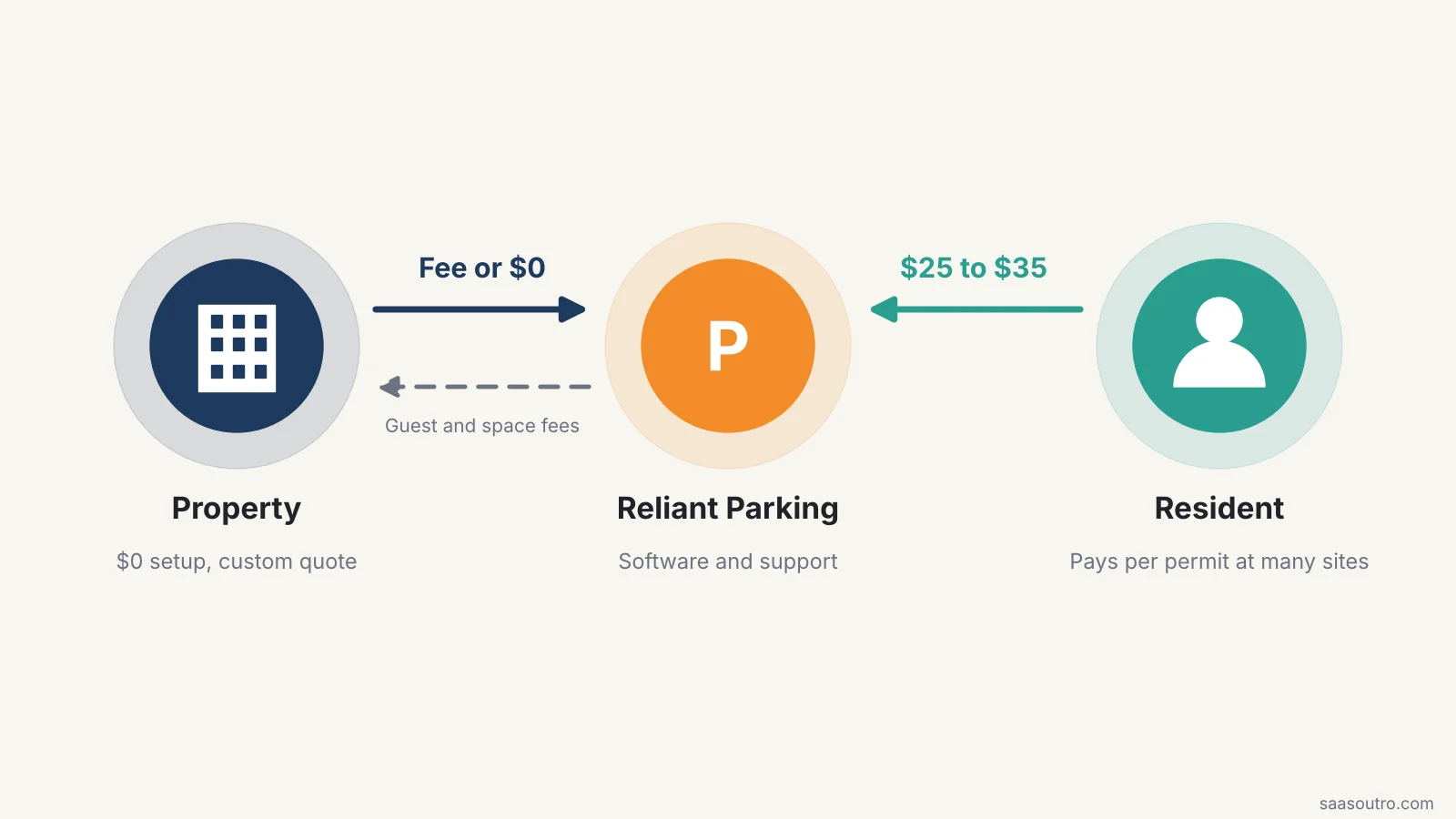 The property pays $0 to set up. At many communities, residents pay Reliant directly for each permit.
So how much do residents pay? Reliant does not say, but the numbers show up in reviews. One App Store review complained about roughly $25 per permit. A Google Play review mentioned a $35 sticker fee. Even a testimonial on Reliant's own homepage says "the $25 is worth paying."
Two details from the terms of sale are worth knowing:
All purchased permits are non-refundable.
Permit fees can change, and renewal prices may differ from what you paid before.
For a property, this resident-pays model can make Reliant feel close to free. For a resident, it is one more fee on top of rent, which I think explains a lot of the anger in the app reviews. If your residents already juggle rent payments, rewards apps and fees (I covered how Bilt works for rent), a surprise parking charge does not land well.
My advice: ask Reliant to put the exact resident permit price, renewal rules and refund policy in writing before you sign. Then tell residents early.
I Tested Reliant's Revenue Calculator
Reliant's homepage has a parking revenue calculator. I wanted to see what it actually does, so I ran it.
The resident calculator opens with 300 spaces, 65% occupancy and a $270 monthly fee. It shows $631,800 a year.
The guest calculator opens with 300 spaces and a $9 daily fee. It shows $985,500 a year.
That guest number is 300 spaces times $9 times 365 days. In other words, it assumes every guest space is paid for every single day of the year. I have never seen a guest lot do that.
Then I put in numbers that feel more like a normal apartment community: 120 spaces, 50% taken, $40 a month. The result was $28,800 a year.
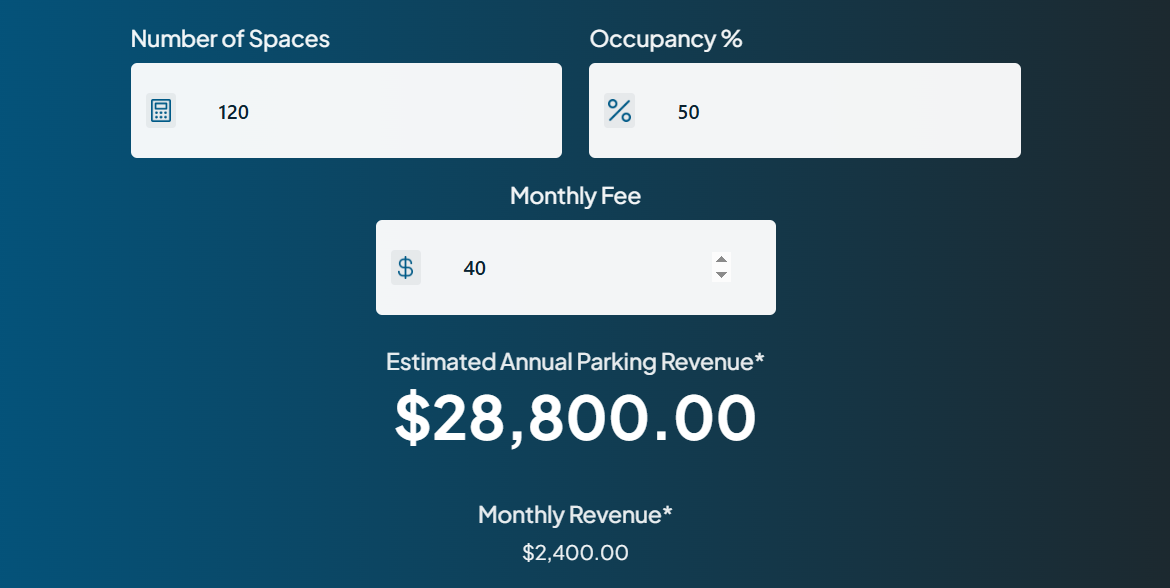 My own run of Reliant's revenue calculator: 120 spaces, 50% taken, $40 a month.
Put next to the defaults, the gap is hard to miss:
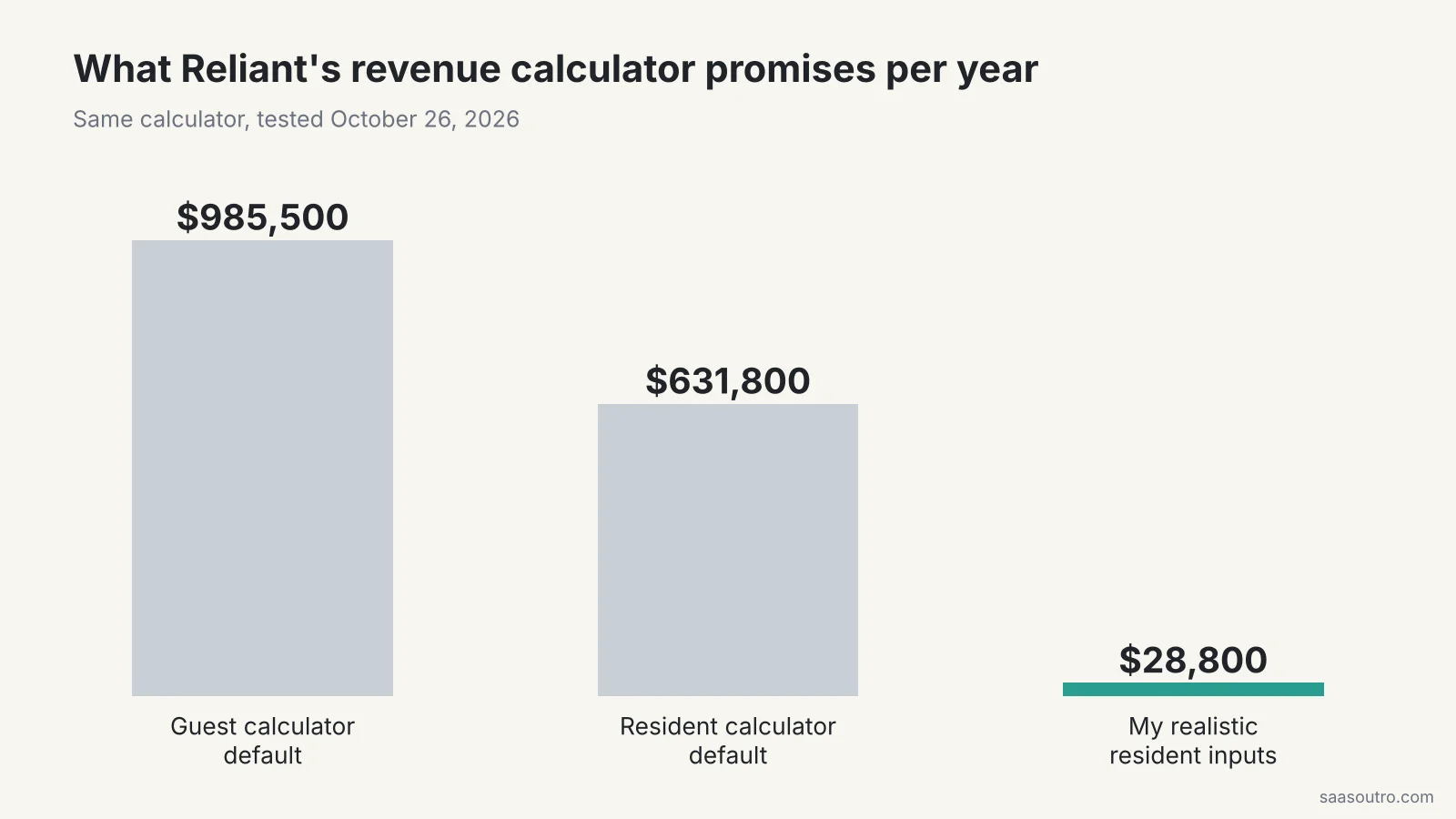 Reliant's calculator defaults next to my own realistic inputs. Tested October 26, 2026.
The math itself is correct. It is just multiplication. But three things bothered me:
The results carry an asterisk, and I could not find any footnote explaining it.
The estimate is gross revenue. It does not take out Reliant's fees or payment processing.
The defaults are set very high, so the first number you see is a big one.
Use the calculator, but type in your own numbers. The default is a sales hook, not a forecast.
The Two Sides of Every Reliant Parking Review
Here is the part most review pages skip.
On Capterra, 60 property managers give Reliant Parking 4.7 out of 5. Customer service scores 4.8. About 82% of those reviews are five stars. On the App Store, 522 residents give the resident app 3.2. On Google Play, it sits at 3.0 with 50,000+ downloads.
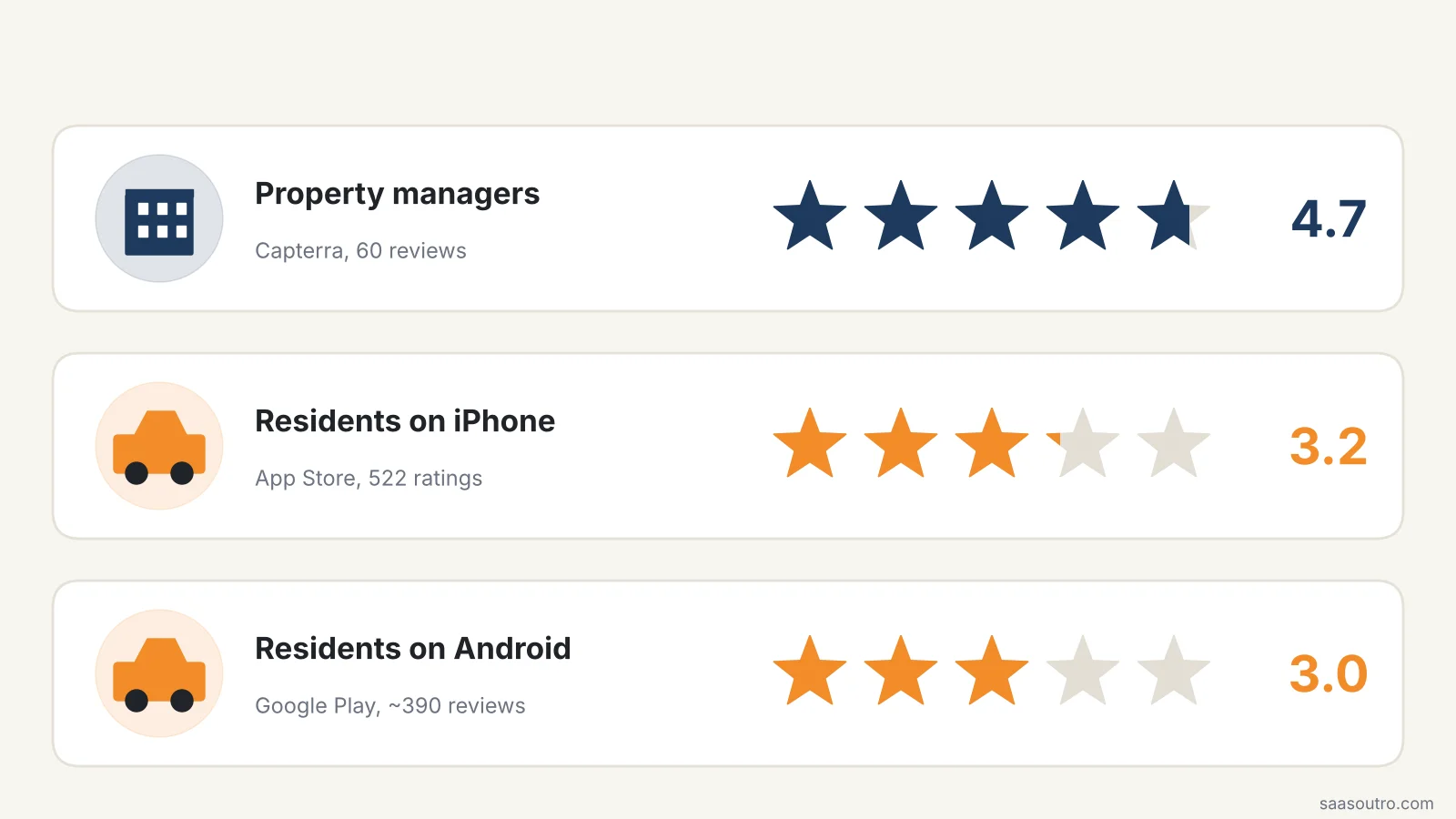 Same software, two very different scores. Ratings checked October 26, 2026.
What managers praise on Capterra:
Easy to learn, with helpful tutorials
Fast, friendly support from real people
Residents can get permits and guest passes 24/7 without calling the office
Real-time reports on parking activity
What managers complain about:
Confusing navigation in places
Hard to sort data without exporting it
Uploading vehicle details takes effort
Older reviews asked for Yardi and Entrata sync, which Reliant now lists
What residents complain about:
Login problems, especially in the app while the website works
Permits denied over documents, sometimes more than once
Long waits or chats that end without an answer
Fees for permits and stickers, and towing for unpaid ones
Two fair points on the other side. Many Capterra reviews were collected by Reliant with a small incentive, and many date from 2019 to 2023. And app store reviews always lean negative, because happy residents rarely leave one.
Still, I would not ignore a 1.5-star gap. Reliant replies to Google Play reviews and pushes regular app updates, including recent fixes to the renewal flow. But your residents will judge your community by this app.
On support: Reliant advertises 24/7 human support, with a phone line for managers and email for everyone. When I opened the chat on its website, an assistant named Riley greeted me and asked for my name before anything else. Residents do not get a listed phone number. They are pointed to the portal, the contact form and email.
If You Are a Resident Using Reliant Parking
A lot of people searching for a Reliant Parking review are not managers. They are residents who just got a permit email, a denial or a tow. If that is you, here is what I found.
Your property chose Reliant, not you. The property decides the parking rules, the permit price and whether there is towing. When a resident complained on Google Play about a sticker fee in an open lot, Reliant replied that the fee covers parking management, vehicle registration, resident support and enforcement tools, and told him to take enforcement questions to his management company.
How to reach support:
in-app chat in the resident app
email at service@reliantparking.com
the contact form on Reliant's website
There is no resident phone number on Reliant's contact page. If the app will not let you log in, try the website. Several reviewers said the web login worked when the app did not.
If your permit is denied: In the reviews I read, most denials come down to documents. My tip is to make sure the name and address on your vehicle registration match your lease, and upload a clear, full photo. If it is denied again, ask support exactly which document failed before you upload anything new.
Before you pay: Permits are non-refundable under Reliant's terms of sale. Renewal is your job, not theirs, and the renewal price can be different from what you paid last time. So check the end date and set a reminder.
If you get towed: The tow is done by a separate towing company, and Reliant's terms say it is not responsible for what enforcement companies do. Reliant's terms also send questions about parking rules to the property. So your first stop is your leasing office and the tow company. Reliant's enforcement app records photos, time and location for each tow, so ask the property for that record if you think the tow was a mistake.
Your data: Reliant's Google Play listing says you can ask for your data to be deleted. That is worth doing when you move out.
Reliant Parking Integrations: Yardi, RealPage, Entrata and MRI
Reliant lists four property management system integrations: Yardi, RealPage, Entrata and MRI. Its integration page is more detailed than most, so here is what actually syncs.
What comes over from your PMS:
resident name and email
unit details
resident status
move-in and move-out status
lease details, if your PMS supports it
unit transfers
What stays inside Reliant:
vehicles
permits
guest parking activity
space assignments
When a resident moves in, they get parking access. When they move out, access is removed based on your settings. That resident data synchronization is the big win, because it stops former residents from keeping valid permits.
Two limits to know. The sync usually runs about every four hours, not instantly. So a same-day move-in may not be ready right away. And Reliant does not say whether parking charges post to your resident ledger, so ask about that in the demo.
If you use a different PMS, Reliant says its team will check compatibility case by case. It mentions REST API connections but does not publish API documentation.
Reliant Parking for Apartments, HOAs and Student Housing
Apartments and multifamily: This is Reliant's core market. Named clients include Essex Property Trust, Alliance Residential, Fairfield Residential and WinnCompanies. If you run a mid-size or large community with recurring parking abuse, this is where it fits best.
HOA communities: The timestamped audit trail and board approval workflows help when homeowners dispute a tow. HOA boards also like that rules are applied the same way to everyone.
Student housing: Move-in week is when parking breaks. Reliant's digital permits and space tracking are built for thousands of requests at once. Expect the same resident-app complaints, though, and students are quick to post them.
Small properties: Reliant says it works from a 50-space HOA up to a 5,000-space complex. For a very small lot, a flat-rate tool may be simpler and cheaper.
Reliant Parking Pros and Cons
Pros
$0 setup, and it can cost the property little or nothing if residents pay
Strong guest parking controls with per-unit limits
Clear enforcement records with photos, time and location
Syncs residents from Yardi, RealPage, Entrata and MRI
Dedicated account manager for each community
High manager ratings for support
SOC 2 and BBB accredited, per Reliant
Cons
No public pricing and no free trial
Resident app rated around 3 stars
Resident permit fees can upset tenants and are non-refundable
PMS sync runs every few hours, not in real time
Enforcement depends on a local partner being available
Revenue calculator defaults are unrealistically high
Reliant Parking Alternatives and Competitors
If Reliant does not fit, these are the tools I would look at. All three serve residential properties and handle parking permit management.
Tool | Best for | Price shown on Capterra | Capterra rating |
|---|---|---|---|
ParkM | Apartment teams wanting simple digital permits | Resident plan $10/user/mo, guest $7 one-time | 5.0 (21 reviews) |
Parking Boss | Managers who want a flat monthly price | Basic $295/mo flat | 4.8 (107 reviews) |
Parkade | Properties focused on parking revenue | Quote, per-space monthly | 4.8 (50 reviews) |
ParkM looks the closest match on paper. Watch the review count, though. Almost all of its reviews were vendor-referred. Reviewers also mention email-only registration and want a proper app.
Parking Boss has the most reviews of the three and a flat monthly price, which makes budgeting easy. The trade-off is that the property pays, and some reviewers call it pricey.
Parkade leans hard into parking revenue management, with space rentals, dynamic pricing and residents subleasing spots. Reliant itself admits Parkade is stronger on revenue tools. Choose Parkade if earning money from parking is the main goal.
A tip: Reliant publishes its own "vs Parkade" and "Parking Boss alternatives" pages. They are useful, but they are written by Reliant, so read them as sales pages.
My Reliant Parking Scorecard
Area | My score | Why |
|---|---|---|
Features for managers | 4.5/5 | Permits, guests, enforcement and maps in one place |
Resident experience | 3/5 | App ratings and fee complaints |
Pricing clarity | 2.5/5 | $0 setup, but no public prices and resident fees hidden in quotes |
Integrations | 4/5 | Four major PMS options, clear sync rules |
Support | 4/5 | Strong for managers, weaker for residents |
Overall | 3.8/5 | Great for offloading parking, weaker on transparency |
Book a demo if you manage a mid-size or large apartment community, HOA or student housing property, parking abuse is eating your team's time, and you are comfortable with residents paying a permit fee.
Skip it if you want public, flat pricing, you want full control of the resident app experience, or parking revenue is your main goal.
Either way, ask these four questions in the demo: What will residents pay, and can it change? Who is our local enforcement partner? Do charges post to our PMS ledger? How fast does a new move-in get a permit?
Frequently Asked Questions
What does Reliant Parking software do?
Reliant Parking manages parking permits, guest passes, space assignments and parking enforcement for residential properties. It has a Manager Portal for staff, a Resident App for permits and guest passes, and an Enforcement App for towing and patrol teams.
How much does Reliant Parking cost?
Reliant does not publish prices. Setup is $0 and the software is quoted based on community size. At many properties, residents pay Reliant directly for permits, and reviews mention fees of around $25 to $35 per permit or sticker.
Does Reliant Parking manage guest permits?
Yes. Residents request guest passes in the app, and managers set limits on how many passes each unit gets, how long guests can stay and how many passes can be active at once. Passes are linked to the guest's license plate.
Does Reliant Parking integrate with Yardi?
Yes. Reliant lists integrations with Yardi, RealPage, Entrata and MRI. Resident, unit and move-in or move-out data syncs about every four hours. Vehicles, permits and guest activity are managed inside Reliant.
Who should use Reliant Parking?
Property managers at apartment communities, HOAs and student housing who want to hand off permit paperwork and enforcement. It suits properties with ongoing parking abuse more than small lots with few problems.
Is Reliant Parking suitable for apartment communities?
Yes. Multifamily is its main market, and Reliant lists large operators like Essex Property Trust and Alliance Residential as clients. Plan for clear communication with residents, because the resident app and permit fees get the most complaints.
Are Reliant Parking permits refundable?
No. Reliant's terms of sale say all purchased permits are non-refundable, and permit fees can change at renewal.
How do I contact Reliant Parking as a resident?
Use the chat in the resident app, email service@reliantparking.com, or fill in the contact form on Reliant's website. The phone number on its contact page is listed for property managers, not residents. For towing or parking rule questions, start with your leasing office.