

Is Search Monitor worth it? Yes, if you pay for brand keywords, run an affiliate program or manage search ads for clients. No, if you only want rank tracking.
Search Monitor does one job well. It watches search results, catches people who misuse your brand, and gives you proof.
The catch is the price. You pay per module, plus keyword crawling fees. And the full number only comes from a sales call.
My verdict in one line: strong at brand protection and affiliate compliance, harder to price than it should be.
Question | Answer |
|---|---|
What is it? | Search monitoring software for brand protection, affiliate compliance and paid search intelligence |
Best for | Brands, affiliate managers and agencies with real paid search spend |
Starting price | From $500 a month, plus keyword crawling fees |
Free trial | Not shown on the official pricing page |
Owner | Similarweb, since March 2025 |
Skip it if | You only need rank tracking or the odd competitor check |
Picture this. You search for your own brand name. Someone else's ad sits right above yours.
It might only show up in one city, or on one phone. You would never know.
That is the problem Search Monitor was built to catch. So I did this properly.
To write this Search Monitor review and pricing guide, I went through the official product pages, the published pricing, and the public reviews on G2, Capterra and SaaSworthy. I have not run the platform on my own account, so I tell you where each claim comes from: the vendor, or real users.
Here is everything I found. This Search Monitor software review covers what it is, how it works, features, pricing and plans, pros and cons, alternatives, and the questions I would ask before signing.
What is Search Monitor?
Search Monitor is a search monitoring platform. It crawls search engine results to protect brands, police affiliates and show what competitors advertise. Its official name is The Search Monitor. Lori Weiman and Shaun Martinec founded it in 2007, and it is based in Orlando, Florida.
Then Similarweb bought it on March 31, 2025.
That matters if you are buying. Similarweb said the deal pairs the monitoring technology with its own digital data. I could not find a published roadmap. So I would ask in the demo whether Search Monitor pricing, support or the platform itself will change.
Now the numbers the vendor gives. It says it monitors 10 search engines on desktop and mobile, including Google, Bing, Yahoo, Amazon, Baidu and Yandex. It says it can crawl from 244 countries and more than 26,000 cities. It also says it has protected over 15,000 brands, and it names Marriott International, Nielsen, Lands' End, Grubhub and Trip.com as customers.
Those are the company's own numbers. I treat them as marketing, not as an audit.
How does Search Monitor work?
Search Monitor crawls search results the way a real person would. It flags anything that breaks your rules, then hands you the proof. Its SmartCrawler checks your keywords across engines, countries, cities and devices. Then it sorts what it finds into violations, competitor ads and market data.
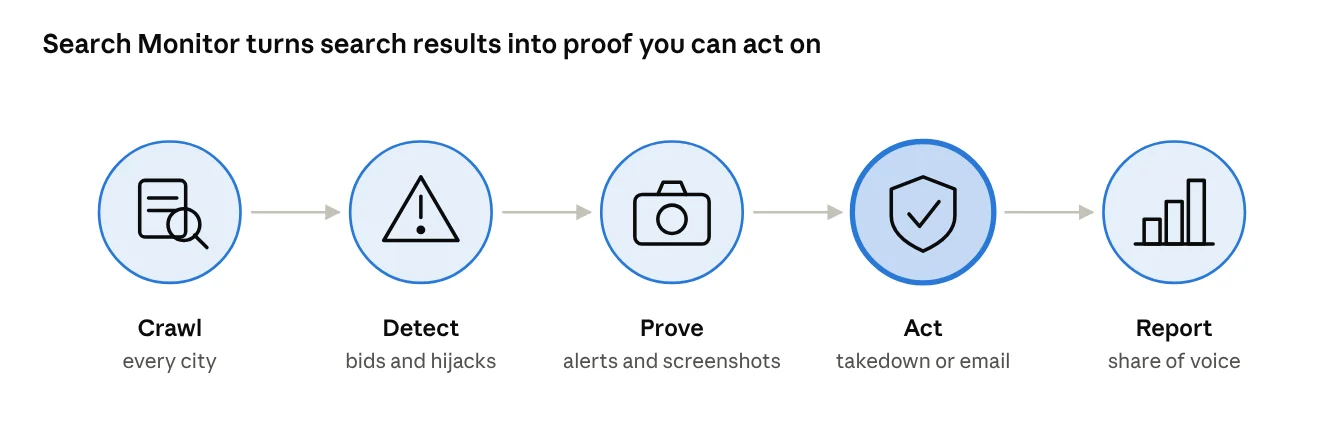 A violation found in step 2 ends in step 4: a complaint to the search engine, or an email to the affiliate.
Setup looks short on paper. The vendor says adding keywords and crawl targets takes under 10 minutes, then you get a session with its specialists. For automated trademark takedowns, you also need your trademark registration numbers.
You choose the crawl frequency, geo-targets, search engines, devices and day parting. So it is automated monitoring that you tune, not a switch you flip. One thing is not public: how crawl frequency changes your crawl fees. Ask.
Alerts come by email when share of voice shifts, ad copy changes or a brand threat shows up. Results export by email, Excel, API and FTP. So your own data analysis and reporting do not have to live inside the Search Monitor platform.
Search Monitor features
Search Monitor has four main modules: Brand Protection, Affiliate Compliance, SEM Insights and Ad Armor. You can buy them one at a time, or as a whole platform. Here is what each one does, and how I would judge it.
Brand protection and trademark monitoring
Brand Protection finds competitors, affiliates and ad farms that bid on your brand name or its typos. Then it files complaints for you. This is the heart of Search Monitor brand monitoring.
Want the background first? We explain brand bidding and how to stop it in a separate guide.
Detects trademark infringement and unauthorized advertising in paid search ads
Sends time-stamped complaints to search engines automatically
Geo-targeting by city, state, region and country
Screenshots of the ad and the landing page as evidence
Share of voice dashboards and custom charts
LiveSERP for up to 10 live, geo-targeted searches
The vendor's own case study says Avery cut its brand cost per click by 64% and grew clicks by 34%. That is one customer's result, not a promise. Still, it sums up this Search Monitor brand protection review in one line: it automates a job many teams otherwise do by hand.
Affiliate compliance and affiliate monitoring
Affiliate Compliance checks whether your affiliates follow your program rules. It looks at their ads and at their landing pages. If you run affiliate marketing, Search Monitor affiliate monitoring is the reason to look at this tool at all.
It detects URL hijacking, brand bidding, ad copy abuse, restricted ranks and coupon code misuse. It also decloaks affiliate links, so cloaked links can be traced back to the affiliate.
Content Monitoring goes one step further. It checks landing pages with pass or fail rules on page text, headers, footers and links. Failed pages get a case file, notes and re-checks. Violations can go out as enforcement emails.
SEM Insights and competitor monitoring
SEM Insights shows what your competitors run across the whole results page. This is the competitive intelligence side of the platform. It covers paid text ads, organic listings, product listing ads, hotel ads, shopping engines on Google, Bing and Amazon, local service ads and vehicle listings. It also tracks AI Overviews on Google and Bing.
You get visibility scores, competitor ads, competitor keywords and ad copy side by side, plus a report builder. That makes it Search Monitor competitor monitoring, ad monitoring and PPC intelligence in one place.
There are two packages. Custom Keywords covers your own list. Lighthouse is a searchable database of more than 200,000 advertisers by industry, with ad spend, for the US and UK only.
Ad Armor and PPC monitoring
Ad Armor helps you stop paying for clicks you would get for free. It builds a daily or weekly negative keyword list, with pause and unpause advice based on rules you set. It looks at your organic rank, your friendly and ignored advertisers, and a list of rivals that should switch your ads back on.
The vendor describes the list as something you upload to your ad account. It claims average ad savings of 20% to 40%. Treat that as a vendor claim.
This is the paid search intelligence side of Search Monitor PPC monitoring. It is the module the vendor recommends pairing with Brand Protection.
Reporting, dashboards and integrations
Reporting looks solid on paper. You get custom dashboards, share of voice charts, alerts and exports. Every plan includes unlimited logins, which helps agencies. Keyword packages start at 100 keywords a month.
Integrations are the gap. I could not find a list of native integrations with ad platforms, CRMs or affiliate networks. I only found exports by email, Excel, API and FTP. If you need a native connection, ask for it by name.
Search Monitor pricing and plans
Search Monitor pricing starts at $500 a month for Affiliate Compliance, $800 for Brand Protection or SEM Insights, and $1,200 for Ad Armor. Every price is plus keyword crawling fees. The whole platform has no listed price.
These are the Search Monitor pricing plans as I read them on the official Search Monitor pricing page on October 9, 2026.
Module | Starts at (per month) | Best for | Included |
|---|---|---|---|
Affiliate Compliance | $500 | Affiliate managers, networks and program managers | SEM monitoring, content monitoring, coupon code monitoring |
Brand Protection | $800 | Well known brands facing competitors on brand keywords | Automated trademark complaints, dashboards, keyword builder, LiveSERP |
SEM Insights | $800 | Brands and agencies that need competitive insights | Custom Keywords, Lighthouse industry data, AI Search Insights |
Ad Armor | $1,200 | Agencies and brands that invest in both SEO and paid search | Negative keyword lists, alerts, performance reports, custom rules |
Whole Platform | Custom quote | Teams that need SEO, shopping, affiliates and paid search | All four modules |
What do all Search Monitor plans include? Unlimited logins. Unlimited keywords, in configurable packages that start at 100 keywords a month. Custom crawl settings, real-time alerts, exports, and onboarding with training.
There is a plan calculator that emails you a custom quote, and a demo form. I did not see a self-serve free trial. Capterra lists one and ITQlick says there is none. So ask sales directly.
What the Search Monitor cost really looks like
Let me keep this plain. The sticker price is only the start, because crawling fees sit on top. Two simple sums show the range:
Affiliate Compliance alone is $500 a month, or $6,000 a year, before crawl fees.
Brand Protection plus Ad Armor, the pairing the vendor recommends, is $2,000 a month, or $24,000 a year, before crawl fees.
Now a quick return on investment check. Say you spend $10,000 a month on brand keywords. That is an example only. Even at the low end of the vendor's claimed 30% to 50% ad cost cut, that is $3,000 a month back. It is more than an $800 plan.
Your numbers will differ. So test it on your own brand terms before you sign. That is the honest way to judge value for money here.
Why other sites show different prices
Search for Search Monitor cost and you will see other figures. ITQlick lists $599 for a Pro plan and $899 for an Ultimate plan, and says it took them from third-party sites. SaaSworthy shows about $600 a month.
I could not match either to the official page. It lists modules, not Pro or Ultimate tiers. So use the vendor's page and a written quote, not a review site's number.
Search Monitor pros and cons
The biggest pros are depth, coverage and automation. The biggest cons are unclear pricing and thin public reviews. Here are the Search Monitor pros and cons, side by side.
Pros
One platform covers brand protection, affiliate compliance and competitive intelligence
Automated, time-stamped trademark complaints save manual work
Wide coverage: 10 search engines, desktop and mobile, down to city level
Decloaking and landing page checks catch affiliate tricks that plain ad checks miss
Screenshots work as evidence for takedowns and partner talks
Unlimited logins suit agencies and large teams
Data exports through Excel, API and FTP
Cons
No full public price. You need a sales call, and crawl fees are extra
Entry prices of $500 to $1,200 a month per module are high for small advertisers
Public reviews are few and mostly invited. Capterra shows 4.0 out of 5 from one review, and G2 shows about six, many marked as incentivized
No list of native integrations, only exports
The user interface gets mixed feedback (see below)
Ease of use, interface and customer support
The vendor's testimonials praise ease of use and support. A Universal McCann executive says the platform is easy to navigate and the support team is responsive.
But hear the other side. A rival, Bluepear, quotes a G2 reviewer who calls the user interface dated and says it struggled with large amounts of data. That quote comes from a competitor's article, so weigh it that way.
One older SaaSworthy review says you cannot set up automatic report emails to the engines. Yet the product pages now describe automated complaint submission. Check that in the demo.
Search Monitor sells enterprise support, with onboarding and personalized training. I found no public support hours or service levels. That is a fair question to put to sales.
Who should use Search Monitor, and who should skip it
Use Search Monitor if brand clicks or affiliate behavior cost you real money. Skip it if you only want rank tracking.
Think of it like a security camera for your brand name. A quiet street does not need one. A busy shopping street does. The chart below matches each module to the problem it solves.
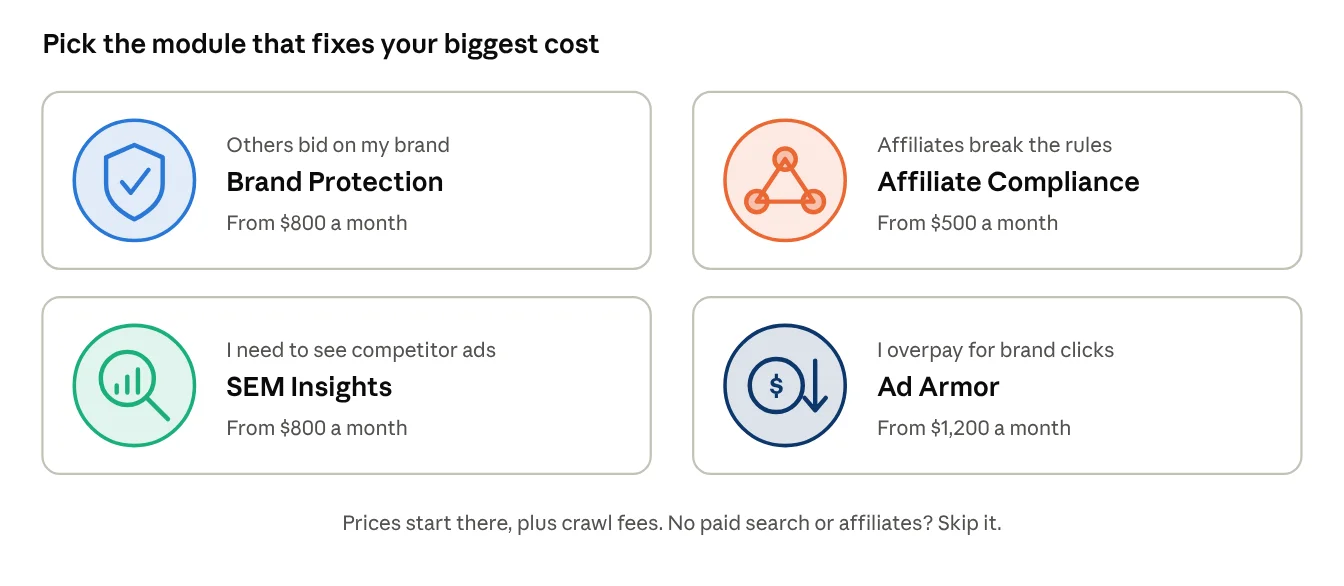 Start with the first question. If the answer is no, a rank tracker is enough. If yes, pick the module that matches your biggest cost.
These are the use cases where I think it earns its fee:
Brands with affiliate programs. Affiliate compliance and brand compliance checks stop partners from bidding on your name or breaking program rules.
Well known brands under constant brand bidding. Brand Protection removes competitor ads and lowers click costs on your own terms.
Agencies running search for clients. Unlimited logins, campaign monitoring and market intelligence reports suit client work.
Travel, retail and local service brands. SEM Insights covers hotel ads, shopping listings and local service ads.
And these are the buyers I would send elsewhere:
Small advertisers with small budgets, because a $500 to $1,200 monthly entry price plus crawl fees is hard to recover.
Teams that only need organic rank tracking.
Anyone who wants public, self-serve pricing and a quick trial.
Search Monitor alternatives and competitors
BrandVerity and AdPolice are the closest Search Monitor alternatives for paid search compliance. Bluepear and Adthena cover parts of the same ground. One 2026 roundup calls BrandVerity and Search Monitor the closest direct pair.
Here is my Search Monitor competitors comparison. These are the best Search Monitor alternatives I found, with what is publicly known about price.
Alternative | Known for | Price noted | Worth knowing |
|---|---|---|---|
BrandVerity | Paid search and affiliate monitoring for brand abuse | Custom pricing, none published | Owned by Partnerize since 2020 |
AdPolice | Paid search monitoring and affiliate fraud detection | Custom pricing | One roundup says it is easy to set up but limited beyond paid search |
Bluepear | Brand bidding, affiliate compliance and link uncloaking | Lite $169 and Business $499 a month, per Bluepear's own site | Newer, and those figures come from the vendor |
Adthena | Competitor intelligence and paid search monitoring | Custom pricing | Strong analytics, but one roundup calls it costly |
How I would choose between Search Monitor and its competitors:
Pick Search Monitor when you want brand protection and competitive intelligence behind one login.
Pick a narrower tool when you only need affiliate checks or only need brand bidding alerts.
If your budget is under $500 a month, Search Monitor's entry price likely rules it out, so price a lighter option first.
Questions to ask before you buy Search Monitor
Ask for the all-in monthly price in writing before anything else. Here are the questions I would bring to the demo:
What is my total monthly cost for my keyword count, including crawl fees?
How does crawl frequency change that cost?
Which search engines, countries and cities are included in my plan?
Does the Similarweb acquisition change pricing, support or the product roadmap?
Can I run a pilot on my own brand keywords before I commit?
How are trademark complaints submitted, and can I review them first?
Which exports and integrations work with my ad platform and affiliate network?
What happens to the price at renewal?
Search Monitor FAQ
What is Search Monitor?
Search Monitor is search monitoring software that tracks paid and organic search results to protect brands, check affiliate compliance and show competitor ads. Its official name is The Search Monitor.
How much does Search Monitor cost?
Search Monitor pricing starts at $500 a month for Affiliate Compliance, $800 for Brand Protection or SEM Insights, and $1,200 for Ad Armor, plus keyword crawling fees.
Is Search Monitor worth it?
Yes for brands, affiliate managers and agencies with real paid search spend. Probably not for small advertisers or teams that only track rankings.
Does Search Monitor have a free trial?
The official pricing page offers a demo and a custom quote, not a self-serve trial. Third-party listings disagree, so confirm with sales.
What does Search Monitor monitor?
It monitors paid search ads, organic listings, product listing ads, shopping results, hotel and local service ads, and affiliate landing pages across 10 search engines.
Is Search Monitor good for affiliate monitoring?
Yes. It detects URL hijacking, brand bidding, ad copy abuse and coupon code misuse, and checks landing pages against your rules.
Who owns Search Monitor?
Similarweb bought Search Monitor on March 31, 2025.
What are the best Search Monitor alternatives?
BrandVerity, AdPolice, Bluepear and Adthena are the main options, depending on whether you need brand protection, affiliate checks or competitor analysis.
Final verdict: is Search Monitor worth it?
Yes, for brands and agencies that lose money to brand bidding or affiliate rule breaking. No, for anyone who just wants to watch rankings. Look at Search Monitor pricing and features together and the picture is clear. It is deep, wide in coverage and built to enforce, not just report. The weak spots are the missing public price and the small pool of recent user reviews.
So what would I do? Request a demo. Bring the eight questions above. Ask for a pilot on your own brand keywords. Then put the written quote next to BrandVerity or AdPolice.
If the numbers beat your brand click costs, it is a sound buy. If they do not, walk away.
That is it. That is my Search Monitor tool review.