

My Marcode review in two lines: Marcode is worth a demo if you run an affiliate program through a network like Awin, Impact, Rakuten or Partnerize and you suspect partners are hijacking your brand ads or leaking coupon codes.
If you only need to watch competitors bidding on your name, or your budget is under $850 a month, I would look at cheaper options first.
That is the verdict. The rest of this Marcode software review shows how I got there.
Marcode Review and Pricing: The Only Number I Could Find
I started with the obvious question. How much does Marcode cost?
The answer surprised me. Marcode does not publish a price anywhere on its own site. Its own product notes say pricing is "tailored to programme scale and keyword footprint". You book a demo, and you get a quote.
The only public figure I found is on its Capterra listing: a starting price of $850 a month, usage based, for the brand protection plan. I treat that as a starting point for a conversation, not a quote.
Let me be clear about how I built this review. I have not run Marcode on a live account. I went through Marcode's website, its product documentation, every public review I could find, and the listings that compare it with rivals. Where those sources disagree, I say so.
What Is Marcode?
Marcode is brand protection software for brands that pay affiliates and run paid search. It was founded in 2023 in London by two people with over a decade in search marketing, and it lists brands like Wayfair, New Balance, Urban Outfitters, B&Q and Zenni Optical as customers.
The Marcode platform has one job. It finds the partners and third parties who take your commission or your ad budget through tricks, and it helps you stop paying them.
Here is the simplest way I can put it. Most brand monitoring tools tell you who is bidding on your name. Marcode is built to answer a sharper question: which of my own affiliates is doing it, and how do I claw back the money?
In practice it is closer to affiliate fraud detection than to classic brand monitoring. That focus on affiliate fraud, rather than general competitor ad monitoring, is what sets the Marcode software apart from older tools in this space. It is also why I spend most of this review on the affiliate side.
Marcode Features
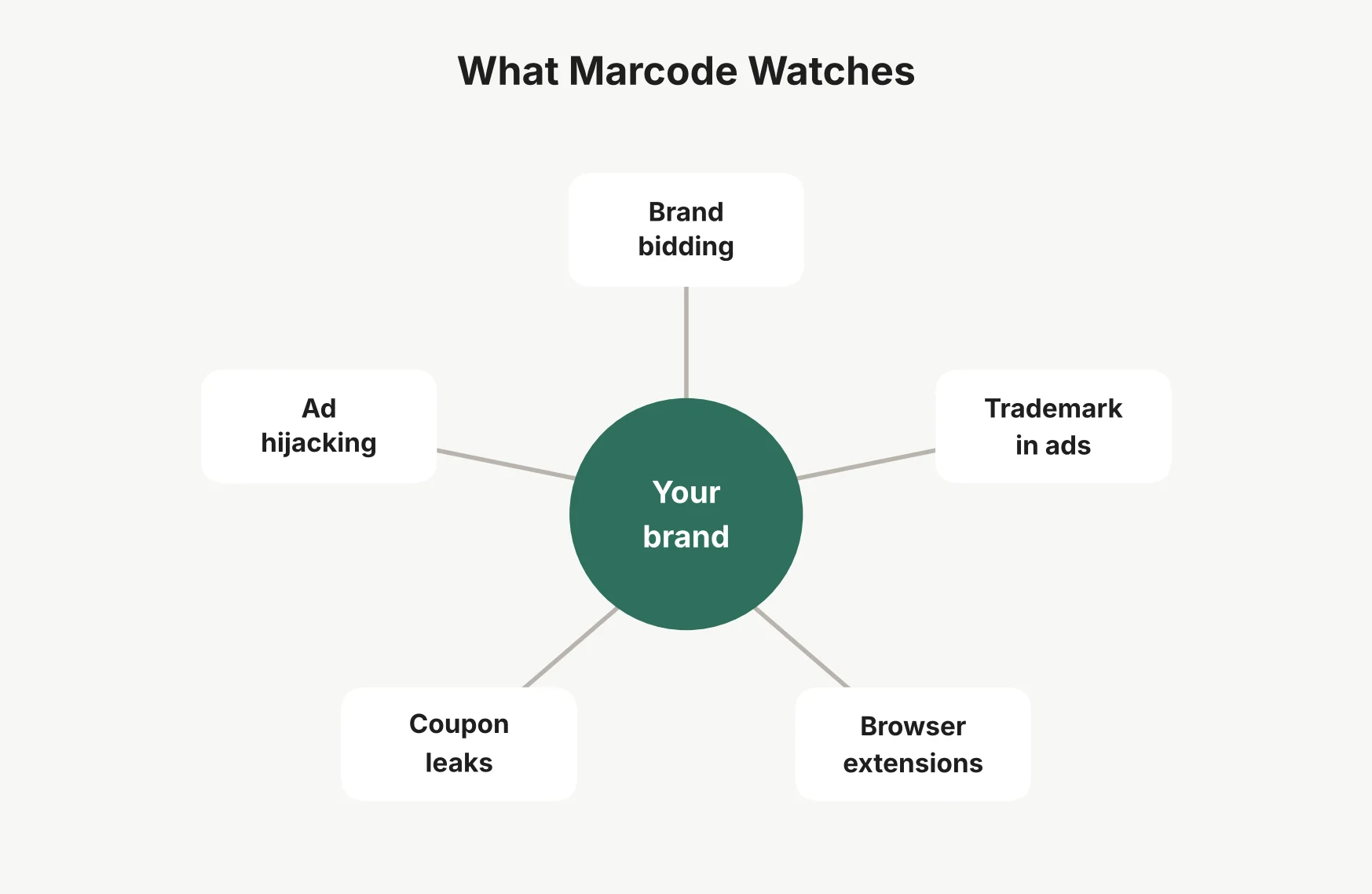 Marcode covers five ways your brand budget leaks, all from one dashboard.
I grouped the Marcode features and benefits into four areas, and for each one I explain the benefit in plain terms. These come from Marcode's own documentation, so I have flagged where I could not confirm a claim.
Brand and Trademark Monitoring
Marcode brand protection starts with search ad monitoring. It checks your branded search terms over and over, from many locations, down to postcode level. Marcode says each keyword can be checked up to 20 times an hour.
That frequency matters more than it sounds. Ad hijackers often run their ads late at night or in one city only, hoping your team never sees them. A tool that checks once a day misses them.
Marcode trademark monitoring works the same way. It looks for your trademark in other people's ad text and can file complaints with Google for you. That trademark complaint automation saves hours if you deal with a lot of trademark abuse.
If you want to know what a Google complaint can and cannot fix, I explain the limits in my guide to the Google trademark complaint process.
One gap I noticed: Marcode's documentation talks about filing with Google. I could not find any mention of Bing. If Microsoft Ads matters to you, ask about it on the demo.
Brand Bidding and Ad Hijacking Detection
This is the heart of Marcode ad monitoring, and the part I think it does best. It runs keyword tracking on your brand terms, logs every advertiser bidding on them, and tries to identify who is behind each ad.
The hard part is affiliate hijacking, a kind of brand impersonation. A rogue affiliate copies your ad, uses your own URL as the display link, then quietly routes the click through their affiliate link.
To you, it looks like your own ad. To your affiliate network, it looks like a sale they drove. You pay commission on a customer who was already searching for you.
Many of these ads use cloaking, which shows a clean page to checkers and the real redirect to customers. Marcode says it has its own anti-cloaking engine to reveal the account and affiliate behind them.
One customer quoted on its site singles out the cloaking detection, but that is a vendor testimonial, so I would test it on the demo.
I wrote a full guide on brand bidding if you want the bigger picture of why this costs so much.
Affiliate Fraud and Coupon Abuse Detection
Marcode affiliate monitoring goes beyond search ads. Two areas stood out to me.
Coupon code abuse. Marcode watches over 50 coupon sources for leaked discount codes and the affiliate IDs attached to them. If a private code you gave one partner shows up on a public coupon site, you find out who leaked it.
Coupon extensions. It also tracks over 50 shopping browser extensions. Some of these pop up at checkout and drop their own affiliate cookie, taking credit for a sale they did not drive. Marcode flags extensions that break your program rules.
Put together, this is affiliate activity monitoring. It watches what your affiliates actually do, not just what ads appear. That is how you catch fraudulent conversions your network report would otherwise pay out on.
When it finds unauthorized affiliates, Marcode can do automated commission cancellation through its network integrations. It can also suspend the offending publisher. This is the feature I think matters most, because detecting commission fraud is only half the job. Getting the money back is the other half.
Alerts, Reporting, and Integrations
The day to day work happens in a dashboard with automated alerts, violation tracking and case management. Marcode also lists:
Affiliate network integrations with Awin, Partnerize, Impact and Rakuten, plus others it does not name.
Google integrations with Google Ads, Looker Studio and Google Sheets for reporting and analytics.
Playbooks, which are rule based actions for common fraud cases.
A task manager with email templates for contacting affiliates and networks in one click.
AI agents that sort and act on findings based on limits you set.
Unlimited users on the plan Capterra lists.
Those software integrations are the part I would test hardest on a demo. Automation only helps if it connects to the network you actually use.
Marcode also says it holds SOC 2 Type II certification and runs a trust center. That will matter to larger brands with a security review.
Marcode Pricing and Plans
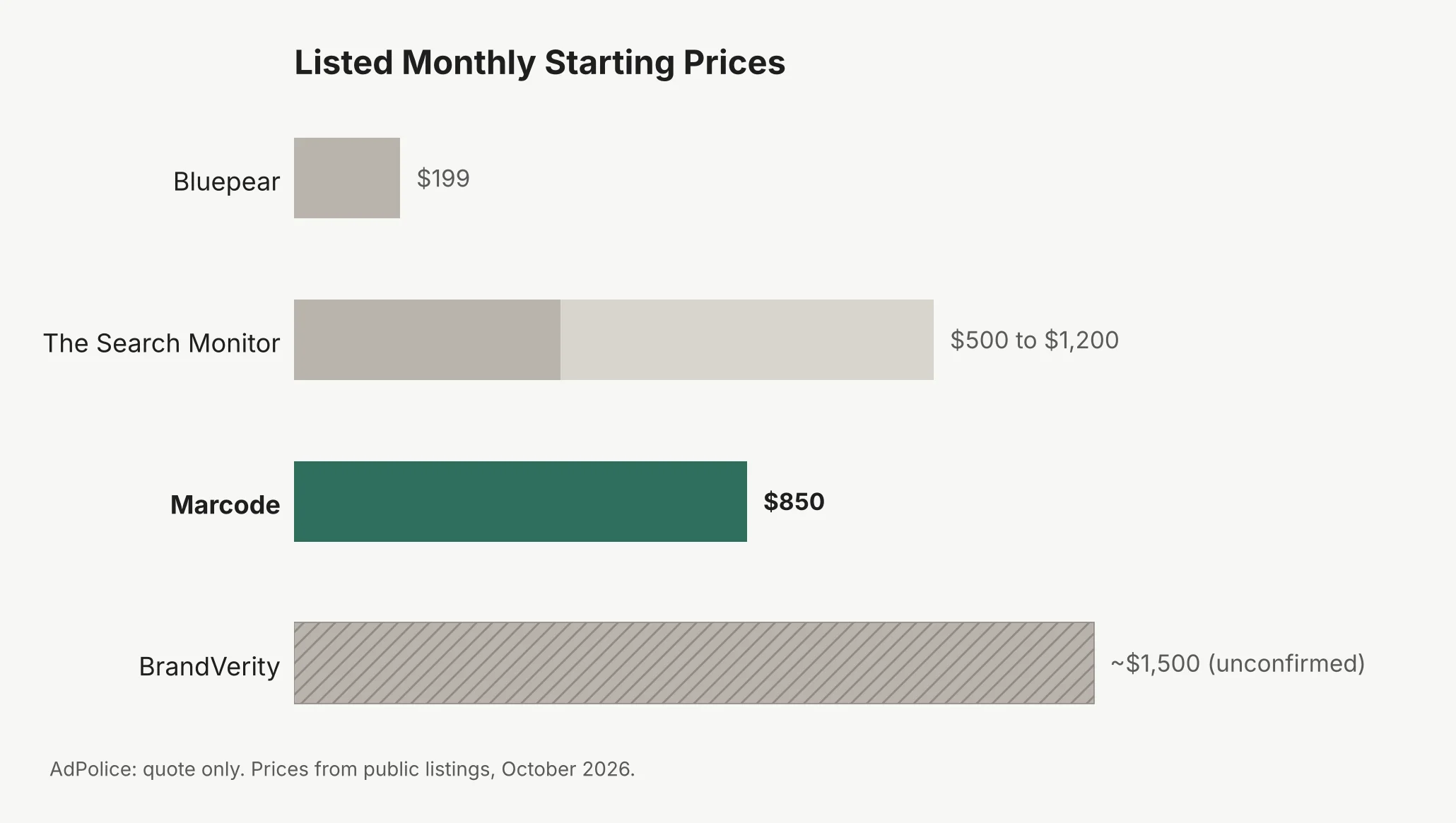 Marcode sits in the middle of the market on listed price. AdPolice does not publish one.
So, how much does Marcode cost? There are no public plans to compare, so here is everything I could pin down on Marcode pricing.
What I checked | What I found |
|---|---|
Public price on Marcode's site | None. Demo and quote only |
Listed starting price | $850 a month, usage based (Capterra) |
What drives the price | Program size and number of keywords tracked |
Free trial | Capterra says yes. Marcode's own docs only mention a demo |
Free version | No |
Users | Unlimited on the listed plan |
Two things here are worth your attention.
First, the Marcode free trial. Capterra lists one, but Marcode's own product notes only mention a live demo. My guess is a trial exists but is arranged case by case after the demo. I would ask directly rather than assume.
Second, it is a monthly subscription with usage-based pricing. Your monthly cost grows with the number of keywords and countries you track.
If you sell under many brand names, in many countries, expect your quote to land well above $850. One Capterra reviewer even wished they could add more of their brands, which hints that each brand adds cost.
Does the Return on Investment Add Up?
Here is the simple maths I would run before the demo.
At $850 a month, Marcode costs about $10,200 a year. To break even, it needs to stop at least $850 a month in commission you should not be paying.
If your average affiliate commission is 10%, that means catching around $8,500 a month in hijacked sales. For a mid-size retail affiliate program, that is not a high bar.
One customer quoted on Marcode's site says the tool paid for a full year in the first month through cancelled commissions. That is a vendor testimonial, so I treat it as a best case, not a promise.
If your affiliate program is small, the numbers can easily go the other way.
Marcode Pros and Cons
Most Marcode software pros and cons lists online repeat the vendor's own page. I built mine from Marcode's documentation and the eight public reviews on Capterra.
One honest warning first: all eight reviews are marked as vendor referred with an incentive offered. They average 4.9 out of 5. That does not make them false, but I weigh the complaints in them more heavily than the praise.
Marcode pros
Built for affiliate fraud. It names the affiliate behind a hijacked ad, not just the advertiser.
Acts, not just alerts. Automated commission cancellation and trademark complaints save real hours.
Covers coupon leaks and extensions, which many brand bidding tools ignore.
Frequent checks from many locations catch ads that only run at night or in one city.
Strong customer support, according to several reviewers who praised fast replies.
Unlimited users, so your whole team can work cases.
Marcode cons
No public pricing, and the only listed price starts at $850 a month.
Speed issues. Several reviewers mention slow loading, freezes and crashes at login. Marcode replied that a July 2025 update cut report waiting times by about 70%.
Insights are not as deep as some rivals, in one reviewer's words.
Dashboard design could be better, another reviewer said, though most praised its ease of use overall.
Few reviews, all incentivized, so there is little independent data.
No clear Bing coverage in its documentation.
Who Should Use Marcode?
After going through everything, here is who I think Marcode suits, and who it does not.
Good fit:
Retail and ecommerce brands with a large affiliate program on Awin, Impact, Rakuten or Partnerize.
Brands that already suspect affiliate hijacking or coupon leaks.
Affiliate managers who want to cancel commissions, not just collect screenshots.
Teams in the UK and Europe, which is where most of the customers on its website are based.
Probably not a fit:
Brands with no affiliate program. Most of Marcode's value is in affiliate compliance.
Small programs where $850 a month is more than the fraud you would recover.
Teams that mainly need competitor ad monitoring or market share data.
Businesses that need Bing coverage confirmed before signing.
In short, Marcode for affiliate marketing makes sense. Marcode as a general search intelligence tool does not.
Best Marcode Alternatives
If Marcode does not fit, these are the best Marcode alternatives I would look at. Each one is a better match for a different need.
Tool | Listed price | Best for |
|---|---|---|
BrandVerity | Not public | Brand bidding and trademark monitoring at scale |
AdPolice | Quote only | Automated takedowns, the closest match to Marcode |
The Search Monitor | $500 to $1,200 a month, plus crawl fees | Paid search monitoring with broad competitor data |
Bluepear | From $199 a month (Capterra) | Smaller budgets that need brand bidding monitoring |
BrandVerity is one of the longest running tools for paid search monitoring and trademark enforcement. It does not publish prices. I would consider it if your main problem is brand bidding across many markets, rather than affiliate fraud specifically.
AdPolice is, in my view, the closest match to Marcode in approach. Both put automated takedowns at the center. If you are choosing between these two, ask each for a trial on the same set of keywords and compare what they catch.
The Search Monitor is the only one here with published prices, spread across four products. It suits teams that want competitor intelligence as well as brand protection. I covered its plans in full in my Search Monitor review.
Bluepear is the most affordable alternative to Marcode I found, listed from $199 a month on Capterra. It covers brand bidding monitoring and affiliate compliance. It is a sensible first step if you are not sure how big your problem is yet.
If your fraud problem is mostly outside search, start with what your affiliate network already offers. Some networks include basic compliance tools at no extra cost.
Marcode vs. BrandVerity and AdPolice
These are the three Marcode competitors buyers ask about most, so here is how I see them side by side.
Marcode | BrandVerity | AdPolice | |
|---|---|---|---|
Main focus | Affiliate hijacking and coupon abuse | Paid search and trademark monitoring | Brand bidding takedowns |
Names the affiliate behind ads | Yes, a core feature | Offers affiliate monitoring | Offers affiliate monitoring |
Coupon and extension tracking | Yes | Not a main focus | Not a main focus |
Automated commission cancellation | Yes, through network integrations | Ask on the demo | Ask on the demo |
Public pricing | No ($850 a month on Capterra) | No | No |
Founded | 2023 | Long established | Long established |
Marcode vs BrandVerity: I would pick Marcode if affiliates are your main problem, and BrandVerity if competitors and trademark abuse across many search engines matter more.
Marcode vs AdPolice: These are close. Marcode leans harder into coupons and browser extensions. AdPolice has the longer track record. A side by side trial is the only fair test.
I have kept these comparisons short on purpose. Each one deserves a full page of its own.
Is Marcode Worth It?
So, is Marcode worth it? For the right brand, I think yes. Here is how I score it.
Area | My score | Why |
|---|---|---|
Features | 4.5 / 5 | Covers affiliate hijacking, coupons and extensions, not just bidding |
Automation | 4.5 / 5 | Cancels commissions and files Google complaints for you |
Ease of use | 4 / 5 | Reviewers like the layout, but several report slow loading |
Pricing clarity | 2.5 / 5 | No public prices, and the free trial is unclear |
Support | 4.5 / 5 | Reviewers repeatedly praise fast replies |
Overall | 4 / 5 | A strong pick for affiliate programs, overkill for small brands |
These scores come from my research and the public reviews, not from a paid account. I would change them after a hands-on test.
If you pay affiliates real money through a major network, and you have even a hint that some of them are hijacking your brand searches or leaking codes, Marcode is built for exactly that. The commission cancellation feature alone can cover its cost.
If you are a small brand, or you have no affiliate program, I would not start here. Run a free check first.
Search your own brand name from a few locations, at a few times of day, and see who shows up. If you find a problem, that is when Marcode, or one of its alternatives, earns a place.
Whichever way you go, ask these questions on the demo:
What will my monthly price be for my exact keyword list and countries?
Is there a free trial, and how long is it?
Do you monitor Bing as well as Google?
Which of my affiliate networks can you cancel commissions through automatically?
How fast are reports today, after the 2025 speed update?
Marcode Questions Buyers Ask
How much does Marcode cost?
There are no public Marcode pricing plans. Capterra lists a starting price of $850 a month, usage based, so I treat that as the lowest Marcode monthly cost. Your final Marcode subscription cost depends on how many keywords and countries you track and the size of your affiliate program.
Does Marcode offer a free trial?
Capterra lists a free trial, but Marcode's own site only offers a demo. I would ask about a trial during the demo call. There is no free version.
What does Marcode do?
Marcode is brand protection software for affiliate programs. It detects affiliate hijacking, brand bidding, coupon code leaks, abuse by browser extensions and trademark misuse in search ads. It can then cancel the fraudulent commissions and file trademark complaints with Google.
Which affiliate networks does Marcode work with?
Marcode lists integrations with Awin, Partnerize, Impact and Rakuten, plus other networks it does not name. It also connects to Google Ads, Looker Studio and Google Sheets.
Can I use Marcode for trademark monitoring?
Yes. Marcode checks paid search ads for your trademark and can file trademark infringement complaints with Google automatically. It does not cover every place your trademark can appear, and I could not find any mention of Bing in its documentation.
Is Marcode good for detecting ad hijacking?
Yes, this is its strongest area in my view. Using Marcode for detecting ad hijacking means it checks your brand terms many times an hour from different locations and tries to name the affiliate behind cloaked ads.
Is Marcode good for small businesses?
Usually not. With a listed starting price of $850 a month, it makes most sense for brands with a sizeable affiliate program. Smaller brands may get better value from cheaper tools like Bluepear or from their affiliate network's own compliance features.
What are affordable alternatives to Marcode for brand protection?
Bluepear is the cheapest I found, listed from $199 a month. The Search Monitor starts at $500 a month and publishes its prices. AdPolice is the closest match in approach but is quote only.
Are there Marcode alternatives for brand bidding monitoring or affiliate fraud detection?
For Marcode alternatives for brand bidding monitoring, look at BrandVerity, AdPolice and Bluepear. For Marcode alternatives for affiliate fraud detection, check your affiliate network's own compliance tools first, then dedicated tools like AdPolice.
Are Marcode reviews reliable?
Marcode has a 4.9 out of 5 rating on Capterra, but from only eight reviews, all marked as vendor referred with an incentive. I would treat them as a useful signal, not proof, and ask for a reference customer in your own industry.